Saturday, August 18, 2012

Update on Swedish Flower X Chicks


Here's another update on the Swedish Flower X Aloha babies!

I'm so horrible with record keeping, I had to go back to emails sent to friends to figure out exactly when these chicks were born!  What I discovered was the Swedish X Aloha cross eggs were collected during a two week period, so our batch of babies were actually born over a period of 10 days, from June 4, 2012 - June 14, 2012.  This means a few of these babies who appear smaller may "even out" a bit as they near maturity.  I sure hope so, because right now there is a great range of body size.

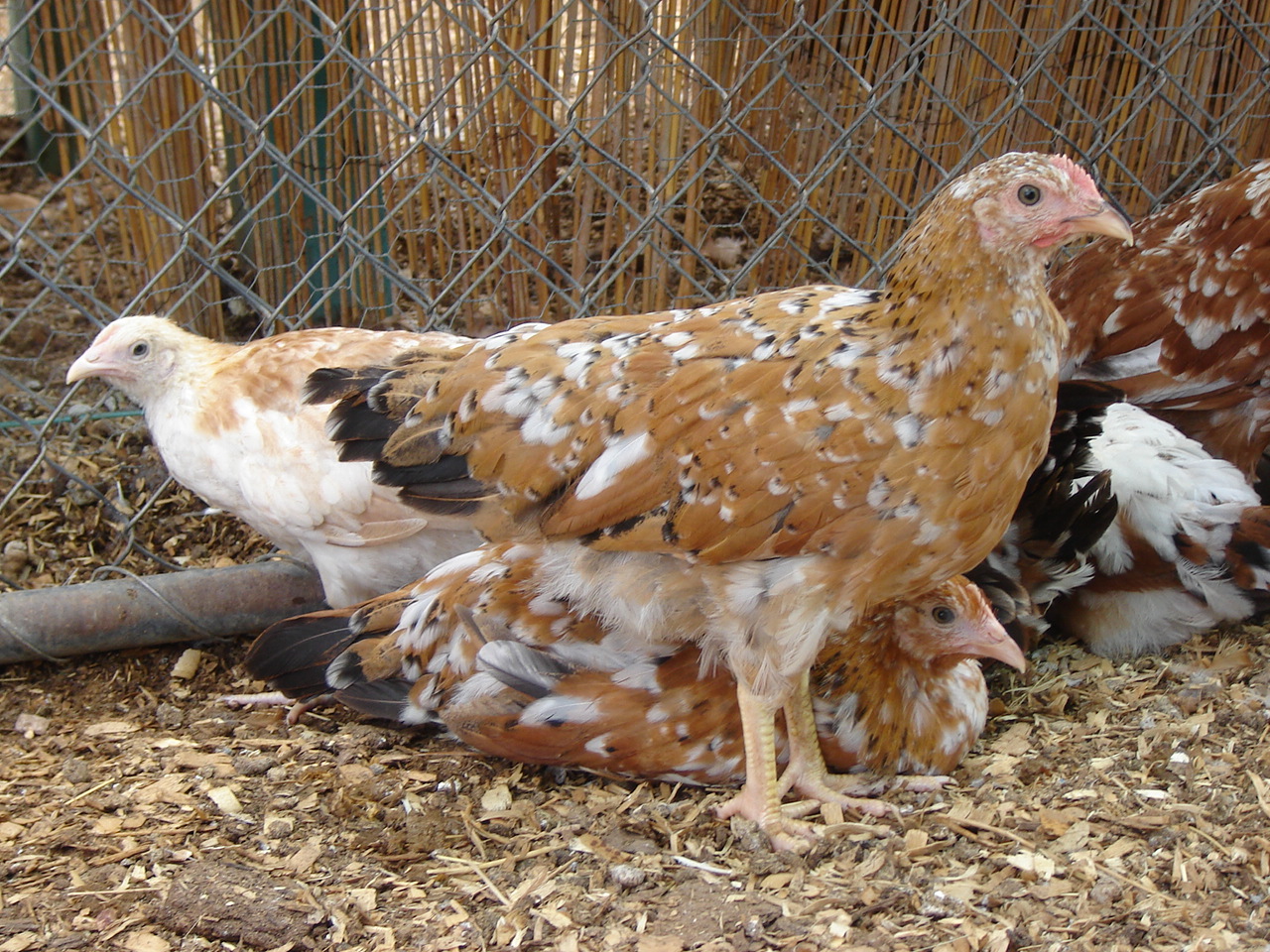
The Keepers:  (At least, for now!)


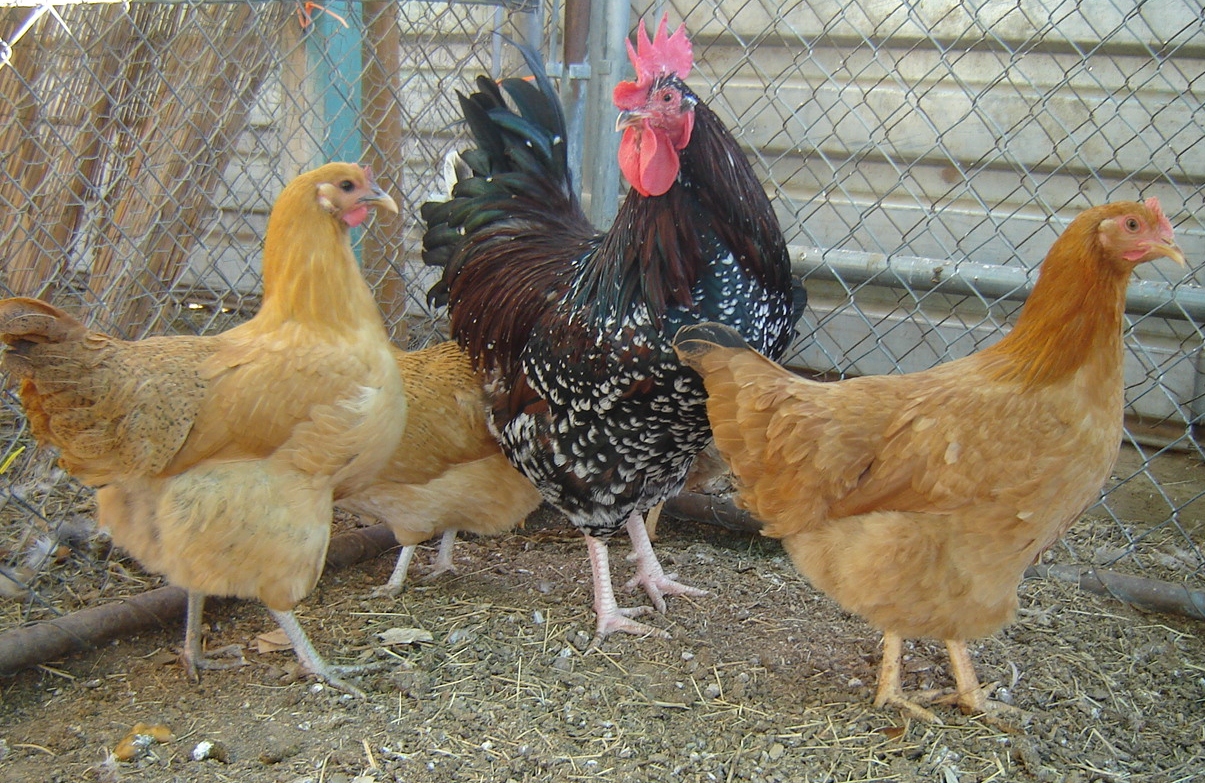
Also,  because of my lack of breeder pens here, all the hens were in with the Swedish rooster, including the (one) full-blood Swedish Flower hen.  It looks like some of the chicks are beautiful purebred Swedish Flowers.  Three hens are very large and Mille in coloring, and are carbon-copies of the Swedish hen at the same age.  One of the trio is just a hair smaller than the rest, but even pure Swedish will show some variance in body size, so this does nothing to help us tell if she's a purebred or not.  Either way, these large Mille hens would go great with that Confetti, all-American (Aloha, Buff Rock, NHR) bloodline rooster next door.


That was the rooster who I mentioned was starting to wander to the front yard with his flock of ladies.  Luckily, the neighbors fixed a missing fence board, and this seems to have resolved the problem for now.  Although chickens are crafty creatures, and the neighbor has a very tempting luxurious green lawn that would tempt any chook.  I hope he survives long enough to be borrowed to use in a breeder pen, as I'd love to cross him with what now appears to be a small flock of golden Mille Fleur Swedish.

This is the non-Swedish rooster.
I'd like to cross with Mille Swedish.
That's the very definition of counting your chickens before they hatch, so back to the chickies!  Anyway, these babies are right around 10 weeks old now.  I've gone through and culled the top third to retain for the breeding program, and have culled many very nice babies from the group.  Will be sad to see them go, but the saying is "breed copiously and cull ruthlessly" so the culls are on Craigslist right now awaiting a new home.

Many of the culls are very attractive!
But a lot had gray legs, or less spotting.
Or showed a lot of black.

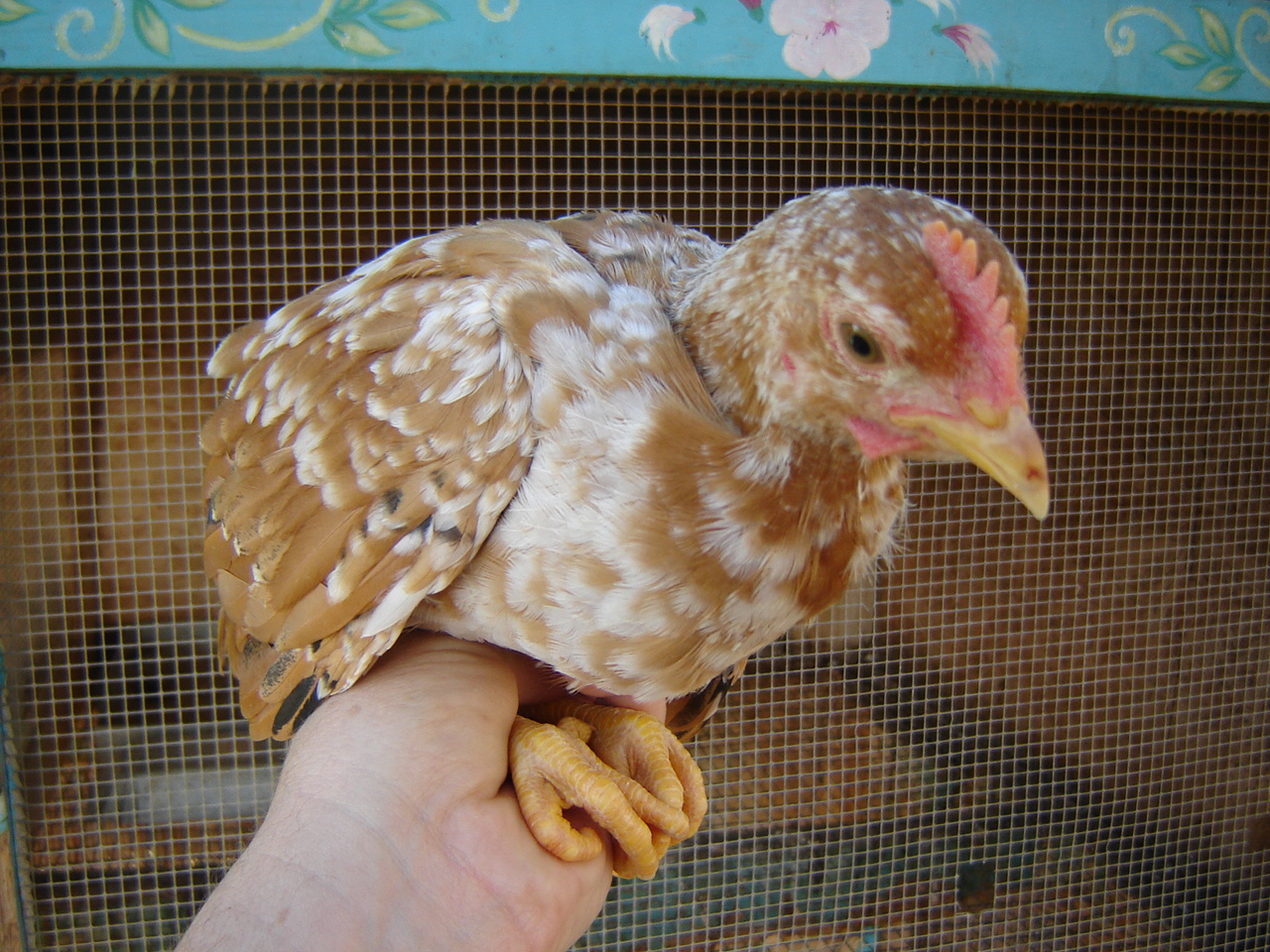
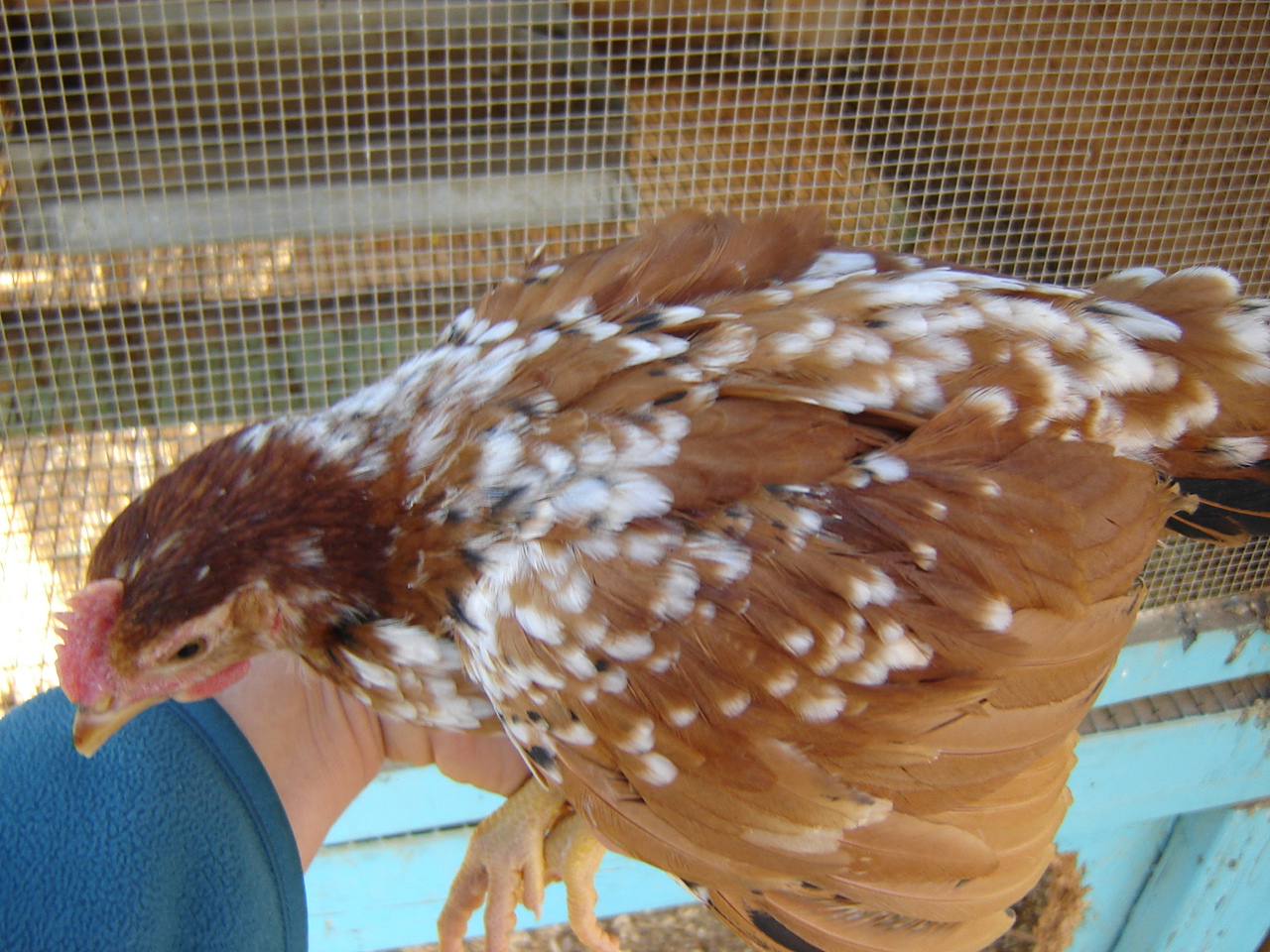
As for the "keepers" I was especially keeping an eye out for traits that are unique to my strain and not seen in pure Swedish Flowers.  A few that are feathering out look promising.
Red rooster to the right, with large upright comb.  Has yellow legs!
This red and white checked shade is not an existing Swedish color.
"Mystery Color" hen.  Not sure what color this is?

She is much smaller than the (likely purebred) Mille Swedish hen.

This interesting rooster has a lot more white than normal Swedish.
More red and less black feathering.

This hen has a total absence of black on her body mottling.
Similar to the Mille Swedes, but not quite?
Smaller, pink legs, more "messy" pattern.

Possible Confetti rooster?  Too bad the legs aren't yellow!
Their early to mid June birthday means that they could be ready to breed by mid to late December!  If all goes well, these cute new hens could be passing their genes to the next stage of my Aloha project, and chicks by these lovely girls could be shipping by Spring 2013!  Many color genes are recessive, which means as these are crossed together, we could see even more new features in their offspring.

Meanwhile, my boyfriend sounds ready and willing to help me build some new breeder pens, which are desperately needed.  Right now I only have one major "communal" pen plus a 10 X 10 dog kennel that can be used as a breeder pen for a small group.  Previously, one way I could use the communal pen would be to pen the other competing rooster (or roosters) and alternate boys over the same group of hens.  But I'm also dealing with growing out a teenage horde of roosters, plus this new group of babies.  Currently, the babies are in the breeder pen, and EVERYTHING else is in the communal pen (about 20 hens and five roos) so right now it's just a big mess in there.

I'd like to have four breeder/grower pens to start.  Likely two of the pens would be used from time to time for other purposes, perhaps housing youngsters in one pen, and maybe another "bachelor pen" for isolating the growing out roosters.  (Keeping those teen boys from acting like punks to the ladies!)

But I'm still confused about how big I can make each pen and still be able to afford the materials?  And if I use two of the pens for other purposes, is four pens enough?  The large communal pen does work really well in summer, when breeding is done for the year.  Do I really want to have to feed four individual pens year-round?  Makes it a hassle for any potential pet sitter, and I do like to travel a lot.

Argh, it all makes my brain hurt!  If I can just figure this out, my boyfriend is ready to help me forge ahead with the project, but only I can tell him what I want, and right now, I'm still brainstorming!

I'd better get it figured out soon, because we saw our first rays of hope arrived in the last couple of days as our furnace-like 115 temps plummeted all the way down to a balmy 101, which feels like HEAVEN in Phoenix right now!  A reminder that fall hatching season is right around the corner . . .

Monday, July 2, 2012

The First Swedish Flower x Aloha Chicks

Shown here at almost one month old, are the very first Swedish Flower x Aloha chicks!

About 35 were hatched.  Aren't they just fabulous?


A small number may need to be culled.  I see one that is way too dark, and a few gray legs.  (I'll let the pink legged ones stay as breeding stock, until I can hatch enough with yellow legs.)  But I see way more keepers than culls!

There were three Swedish roosters running with my Aloha flock, and the dominant one featured a blue tail.  He's now moved on to Laree's house to cover her Aloha flock this fall.  I've kept the black-tailed rooster for myself.

My purebred Swedish rooster, who will be crossed with little full Aloha hens.
If these cuties can make it though the summer, they would be mature by December.  That means I could possibly have a breeder pen of 1/2 Aloha, 1/2 Swedish hens to use for Spring hatching!  These could be incredibly valuable paired with other half-Aloha crosses.

Here is a rooster that is NOT a Swedish Flower, but Aloha.  He has some Buff Rock in his pedigree, to improve size and type.  If he was paired with half Aloha, half Swedish, his kids would be 1/2 Aloha, 1/4 Swedish, and the remainder mostly Buff Rock.  This Buff Rock blood Aloha rooster can help fix the pink legs on the half Swedish, half Aloha babies:

Aloha Rooster with added Buff Rock bloodlines.
Another possible use for the half-Swedish chicks, especially those that showed lighter color, would be to use them on very colorful Aloha roosters.  This rooster in particular needs to be given a flock of hens:
Older bloodline, FULL Aloha rooster.  Hatched 2009, I think?
Would also be great crossed with yellow-legged 1/2 Swedish Flowers.

Sunday, July 1, 2012

This is an Aloha Chicken.

This spring, I gave my new neighbor a batch of young Alohas.  I included what looked to be a few "Confetti" colored roosters.  Not because they failed to look promising!  It's just that with the Confetti color, you should not cross two Confetti's together, or the Barring will become dominant.  So you can have a Confetti rooster, OR Confetti hens.  Otherwise the gene will "take over" and soon your flock will be ONLY this color and nothing else!  Since I love all the colors, including my orange mottled Ginger girls and all the other fun Aloha shades, this is not acceptable.  I certainly wasn't giving up my adorable Confetti colored hens!  So, I gave my neighbor the baby Confetti roos.  (I did not get any Confetti hens from this batch.)

Well, look what grew up out of this batch.  I suspect, judging from size and type, that Cheeto was the dad.  I guess not ALL of his sons will lose their color?  Look at this guy now:

NOT a Swedish Flower Rooster - It's an Aloha!
He has good size. A deep body.  Bright yellow legs.  Sizable single comb.  Unique color not seen in any other standard size, dual-purpose breed.  His tail does need improvement, it could be much longer.  But that is his only fault.  I can officially say that this is an actual Aloha chicken!  YAY!

Aloha rooster - contains Buff Rock and NHR + Origianal Aloha Stock.

Now this fellow has to survive the AZ summer temps, and my neighbor's stock has started to wander into his front yard!  While he takes wonderful care of his chickens, he can't protect them if they leave his fenced yard.  This guy is literally one roaming dog attack away from being history.  If he can make it just a few more months, I have a pure-bred Swedish Flower Hen that I'd love to hook him up with:

Pure Swedish Flower hen

Speaking of long or short tails, check out this young rooster, who is obviously of strong Sussex lines.  Both Sussex and the original Aloha stock (which carries a bit of Exchequer Leghorn) have extremely long tails, and this little fellow got a double-dose of flamboyant tail genes!  Wonderful!  Check it out:

What a tail on this youngster!  Wow!
He also has copious amounts of big, bright spots on his chest.  And, while his color is brown, it's not nearly as dark as a pure Sussex.  His faults:  Too small.  Pink legs.  So he needs to be bred to very large hens with yellow legs.  Luckily, I have two new pure Buff Rock pullets the same age as him.  These new Buff Rock gals are sweet and friendly.  Buff Rocks have HUGE size, but short stubby tails.  I'm hoping he will give those hens the genes for bright mottling, and help improve the tail length.  The babies would not show any spots, but would carry them.


Cheeto Chicks, All Grown Up.

The Cheeto Chicks:  Final Results!

A very puzzling thing happened with these three colorful Cheeto chicks.  As they matured, they all began to lose their spots almost entirely.  I have heard a few references to this phenomenon, but since so few folks have been trying to create new mottled birds until recently, there is still a lot to figure out.

At any rate, the three rooster chicks do have some small amounts of white here and there, so I'm giving at least one of them a shot to see if he will produce chicks that show more color  (and keep it to adulthood.)  This is also going to change the way that I evaluate chicks.  The babies that previously, I'd say carried "too much white" may need to be kept around for a while to see how they end up.  Also, I have heard from Mottled Cochin breeders, that the roosters tend to lose a lot of white as they mature, while the hens will often keep their white or gain even more white as they age.

The only colored chicks in this batch were all male, (the single colored hen chick had to be put down) so I'll be eager to try another test batch of Cheeto-chicks in the fall.  I can't wait to get some baby pullets with this much white that are sired by Cheeto.  Will I have better luck keeping the white color on Cheeto's daughters?  Time will tell!

Now - pictures!  Remember these are the same three chicks shown previously, and they are all the same age.

The first photo shows the rooster chick that showed the MOST white as a chick.  Kind of discouraging, isn't it?  Where did the spots go?  Ha ha!

Weedy, lanky, not of good body type.  Nice yellow legs, though.
The tallest rooster, but seems slow to mature and not as plump.
Third rooster.  Great stout body type, big comb. closest to Aloha body type. 
I'd like to see a long, flowing tail on rooster #3, but overall this is a nice Aloha body type that I'm working towards.  Practical, too, as this bird is the most meaty and "ready to butcher" of the three, I think?  The goal is to have Alohas be a practical, dual-purpose farm breed, good egg layers, but when you hatch chicks and end up with too many roosters, the extra roosters should be large enough to eat.

Not that I've ever been able to eat one of my chickens in all these years of raising them.  If anything, having my pet project flock makes me lean towards eating beef, ha ha.

I'm leaning towards rooster #3 for being the most practical.  Another note, the three roosters caught some kind of bug early on.  I medicated them once, and it went away, only to come back in roosters #1 and #2 while Chunk #3 seems to have overcome it all on his own.  Bonus points for strong immune system!


Wednesday, March 14, 2012

Cheeto's Pack of Chicks!

Back in January, I'd set up Cheeto, my big "orange" rooster, with a select group of my very favorite hens.  These hens all carried color, but more than that, despite being small they had nicely shaped bodies without any of that "gamey" look that the original Aloha stock tends to favor.

These hens were kept exclusively with Cheeto for one month and never once mixed with any other roosters.  The idea was to see if Cheeto actually carried the genes for color.  Odds are actually against it - as Cheeto is 75% "big chicken" and only 25% Aloha.  Which basically meant a one in four chance that Cheeto carried the recessive genes for spotting.


Well, good news!  Today all 13 chicks hatched are all alive and well.  And four of them are really colorful!

They are almost six weeks old at this point.  
And here are photos of three of those babies that appear to be roosters:
Chick #1 (above and below)

Chick #2 (above and below)

Chick #3 (above and below)


Color?  Oh yeah, we got color!

There seems to be one hen chick with color, shown below:


The rest of Cheeto's chicks are mostly solid buff, but a few show tiny bits of white here and there.  Those teeny white specs very well may fade out as the chickens mature, but even if they fade, it clearly "marks" those chicks as carriers of the mottling gene.

Which leads me to the final comment of this post . . .

There were several half Buff Rock chicks that I hatched out last year.  Why did I pick Cheeto?

One day, I was feeding the chicks, who were about three months old at the time.  Cheeto moved his wing a little bit, and there on the very teeny tiny tip of ONE single feather was a trace of white.  I have never really found this feather again, by the way!  The amount of white was THAT small.  Just a trace!

I pounced on Cheeto, and immediately carried him to the house, and tagged his leg with a blue zip tie.  He carried that tag until adulthood, as he was identical in every other way to the several buff chicks I'd hatched from this cross.

A few years ago, I had a hen out of mottled dad, who was solid except for one white wing feather.  When I crossed her back to a mottled rooster, she gave me some of the most colorful chicks I'd ever seen!  So keep an eye out for "solid" chickens if you are breeding for Mottled color.

Check them carefully for clues that they carry the gene.  Here's an example of a hen that looks solid but is a mottled carrier.  See the white tip on the tail feathers?  It's the only white she has, but I'm sure her chicks will be quite colorful if she's bred to the right rooster!  Click on the photo below to make it larger, and look carefully at the very end of those tail feathers.

(There is just a teeny tip of white on a couple tail feathers on this girl.)

Color genetics are so much fun!

Wednesday, February 8, 2012

Update on the Fall 2011 Chicks

I've only managed to hatch out about 24 Alohas this fall, way less than my "normal" hatching schedule.  (Been traveling a lot!)  Four chicks were hatched out naturally when a hen took over and I didn't have the heart to break up her nest.  The other 20 or so chicks were hatched in an incubator, around Thanksgiving.

First up, the four October chicks!  Here's two of them shown at a month old:

Two of the four October chicks, at one month old.  
The chick in the background has since completely lost his spots.
He now appears solid buff!  
The other chick appears below.
The only one of the four October chicks that I'll be keeping to grow out.
He does have Barring, but his buff mottled color is very unique.

One of the buff mottled chicks has now actually lost his spots - very strange!  He now looks orange with one white wing feather.  He will be culled.  The most promising chick looked very bright red/white mottled, and was very large, but also shows lots of barring and puffy cheeks.  Not helpful.  The hen developed leg issues and was culled.

Which leaves this one baby rooster to grow out for a while.  He too shows barring, but the buff/white pattern has been hard to get:

Getting a nice Buff Mottled chicken has been very tricky.  I wonder why?

Next up - November chicks!  Some were by Cheeto, who was running in the "big pen" with Flame and two other roosters with mostly small Aloha hens, but also I added two large purebred Sussex hens.  So it was a big old mess in there, and I don't know who was with who, exactly.

In the small breeder pen was a HUGE pure Sussex rooster with several big buff hens:


Some of these big yellow hens should have also carried the Mottling genes.  Overall, MANY of these chicks hatched were half Sussex - either their dad was this big Sussex rooster, or their moms were one of the two pure Sussex hens in the main pen.

What is surprising is how much many of these chicks resemble purebred Sussex!  I can't even tell the difference right now.  Can you?

Above and below - NOT pure Speckled Sussex.  Only half.  
But they look like "regular" Sussex to me???
Three are hens and will be kept.  I'm hoping some fun colors are hiding behind that boring brown-ness:
Check out the huge "Sussex" rooster on the bottom right.  He's half Aloha.

I may even keep one of the biggest flashiest Sussex-y roosters, just as a test.  There were absolutely NO Sussex-to-Sussex breedings in this pen!  All of these are only HALF Sussex.  What sort of colors are lurking behind the sea of dark mahogany?  Will all sorts of colors pop out next time?  Or is the Sussex mahogany color just that strong?

For those of you working with your own Aloha programs - this is why you need to introduce other breeds into the mix.  Sussex color is very dominant, so try to mix in some New Hampshire Red or Buff chickens to break this color up.  I have been reluctant to introduce a lot of Sussex blood into the program.  It needs to be added as a "dash" or else you end up with what looks like a really lousy flock of purebred Sussex.

Of the seven Buff chicks (probably sired by Cheeto) in the November hatch, several showed mottling at first, but like the previous October buff chick, the delicate mottling is simply fading away.  These buff roosters were re-homed.  Three of the chicks did show buff/white - but WAY too much white!  Those were also rehomed.

Too much white, or not a enough white, what a mess!  Nine buff and white chicks total.  Only the one guy shown HERE had the perfect mix of yellow and white:

Buff Mottled - only this fellow is the perfect blend.  
Everyone else was culled, too much white, or not enough.
Buff Mottled is proving to be a "tricky"color so far!

Many other chicks showed too much barring, all over.  Nice, but you have to watch the Barring gene, it can become dominant in a jiffy.  Use it sparingly!  Ha ha.  These will also be culled.

Beautiful!  Yet barred.  Lots and lots of Barred chicks in this group.
Another barred beauty that will be culled.  

Which leaves me with a few hens that look exactly like Sussex hens (but are really only half Sussex - so hopefully they will give me some new colors when bred to the right roosters.)  And one rooster who is a good mix of Buff and White, but sadly has the barring.  (I may cross him with the half Sussex hens?)  But he's the only decent yellow/white so far.  Besides the barring on the buff/white guy, he's also kind of small.

And last, there is this rooster:

The best rooster prospect so far.  Light brown, decent white, no barring so far.  
Good size.  Will see how he grows out.

This guy has gorgeous light brown color and white flecks.  Looks very promising!  Best of all, he looks NOTHING like a Speckled Sussex.  Ha ha!  It's pretty tough to make it into the Aloha program here!  If they're lucky - six chicks might make it into the breeding pen for next season.  Will update on the remaining roos and the few hens as they grow out.

More chicks in the brooder . . . more eggs in the incubator . . . here we go again!

Tuesday, February 7, 2012

Let's Get Hatching! (Again)

After a long delay, it's time to gear up for lots of hatching this spring!

I went out of town for the first three weeks of January, which meant I had to hold off on hatching out new chicks during that time.  Lucky for me, a friend of mine and fellow Aloha member, kept hatching in my place!  Larissa managed to get about 30 Aloha chicks.  They were partly from some of my eggs, plus some from her own Aloha breeding pen.  Yay!  So there are many New Year's chicks hatched and growing at Larissa's.  Will update with photos as hers develop.

Then she set two dozen eggs of mine, that I'd saved from a "special" breeding pen featuring Cheeto and a select group of four awesome girls.  The goal:  to scientifically determine once and for all, does Cheeto carry the recessive Mottling gene?

Above:  Fabulous Cheeto: 1/2 Buff Rock, 1/4 NHR, 1/4 Confetti Aloha.
But does he carry Mottling?

Well, the darn guy ended up only covering HALF the girls; because only 14 of the 24 eggs were fertile.  Ten were sterile and tossed out.  GRRRRR.  (A rooster should be able to handle up to 8 hens at a time, so covering only four hens should not have been an issue.)  This means my experiment isn't complete yet, as I don't know whose eggs developed and who was left out?  But it's a start.

The result was 13 healthy chicks in various shades of buff and gold.  All of these are "for sure" carriers of bright colors - just look at the moms!  So even if these baby chicks don't show mottling when grown, I can safely keep any of the hens, knowing they will carry some fabulous color genes.  Even if they appear solid when grown.

The new chicks!  All of these are Cheeto's babies.  Some hens will be kept for the program.

Remember - Sussex-type Mottling is recessive.  It can disappear easily when you breed Mottled to Solid, but it should come back later when bred to another mottled carrier.

According to "theory" - if Cheeto is a mottled carrier, because these hens all show color, the babies should be half Mottled, half Solid in color.  About half would show visible spots on their chest, wings, or tail, though the number of spots or the size of those spots may vary.

If he does not carry Mottling, the chicks will all grow up to be solid in color.  (Though there may be a stray white feather tip or random single white feather that is a "tell" that the gene is there, in hiding.)

Either way, the hens from this cross should be bigger in size, light in color, and good layers, and great for the breeding program.  All hens will CARRY the genes for spots, even if they don't show it.

I'm bummed that the eggs were not ALL fertile, because I don't know if this batch includes the offspring from my two favorite hens!  All four of these hens are fabulous, but I especially like these two:

Hen with bold spangles - 1/2 Sussex 1/2 Aloha


Hen with light "mille" pattern - 1/4 Sussex, 1/4 NHR, 1/2 Aloha.

The other two hens are also lovely, but I have to see if I can get Cheeto's lighter base color onto these Sussex/Mille color patterns.  One of my goals is to get a true, gold/black/white Mille on a big chicken.  (Similar to a Mille D'Uccle Bantam.)  The two other hens are also great in color and body shape, but they are red and white - not the Mille "tri color" pattern, so I'll put them back in the main pen for a bit:

A third hen in Cheeto's pen - yellow legs, and red/white mottled color.  Only black is in her tail.

So my next step will be removing the two red/white hens, waiting for these remaining tri-color hens to lay a few eggs, and taking those eggs to Larissa to see if they end up "blanks".  (Though I have no idea what I'll do if they are blanks?  Play romantic music in the coop?  Rose petals on the coop floor?)

Will update with progress on the new batch of fuzzy yellow puffballs!  Wish I knew exactly which of these hens are the moms?  Crossing my fingers and HOPING for SPOTS!