Wednesday, March 14, 2012

Cheeto's Pack of Chicks!

Back in January, I'd set up Cheeto, my big "orange" rooster, with a select group of my very favorite hens.  These hens all carried color, but more than that, despite being small they had nicely shaped bodies without any of that "gamey" look that the original Aloha stock tends to favor.

These hens were kept exclusively with Cheeto for one month and never once mixed with any other roosters.  The idea was to see if Cheeto actually carried the genes for color.  Odds are actually against it - as Cheeto is 75% "big chicken" and only 25% Aloha.  Which basically meant a one in four chance that Cheeto carried the recessive genes for spotting.


Well, good news!  Today all 13 chicks hatched are all alive and well.  And four of them are really colorful!

They are almost six weeks old at this point.  
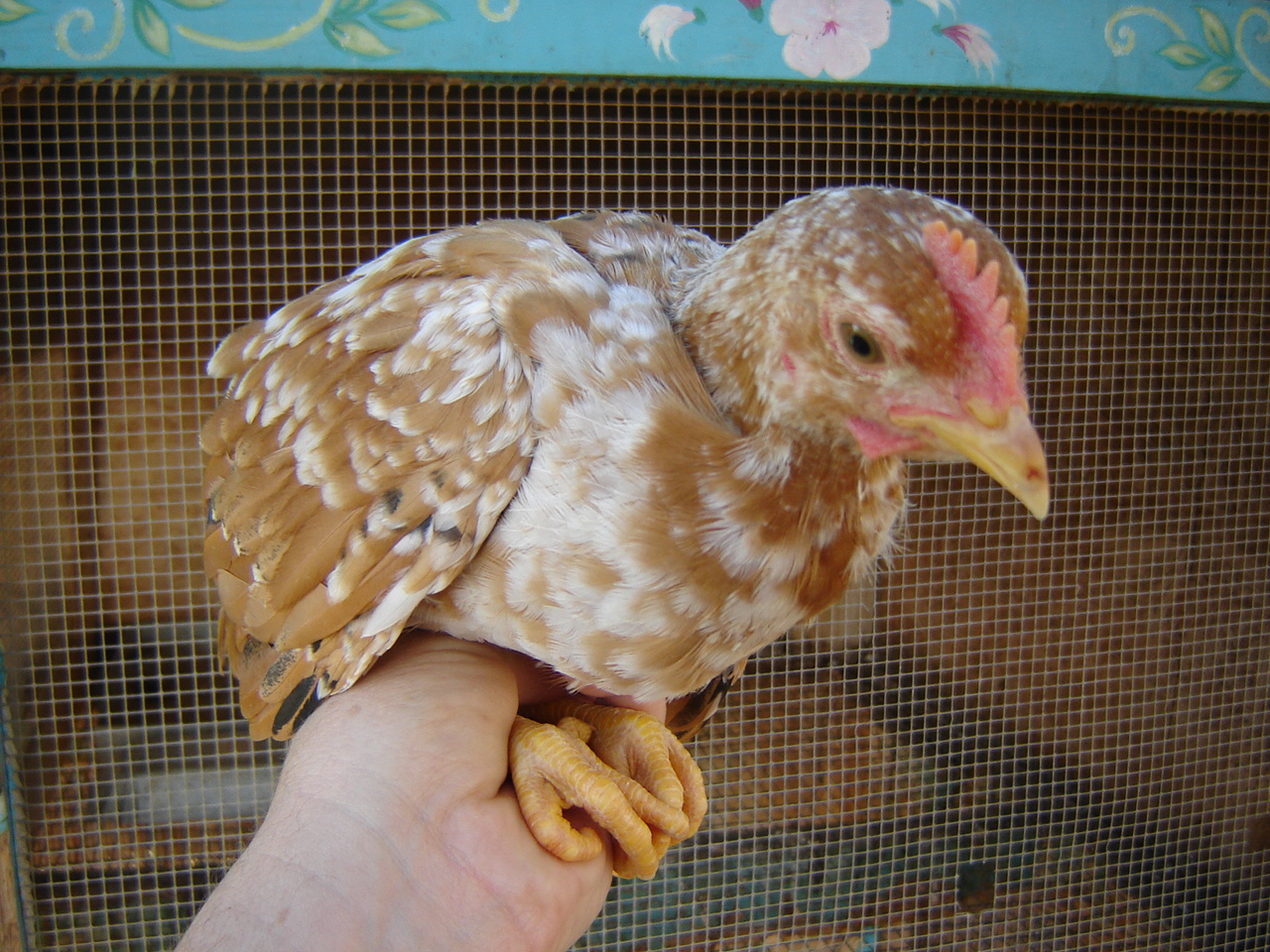
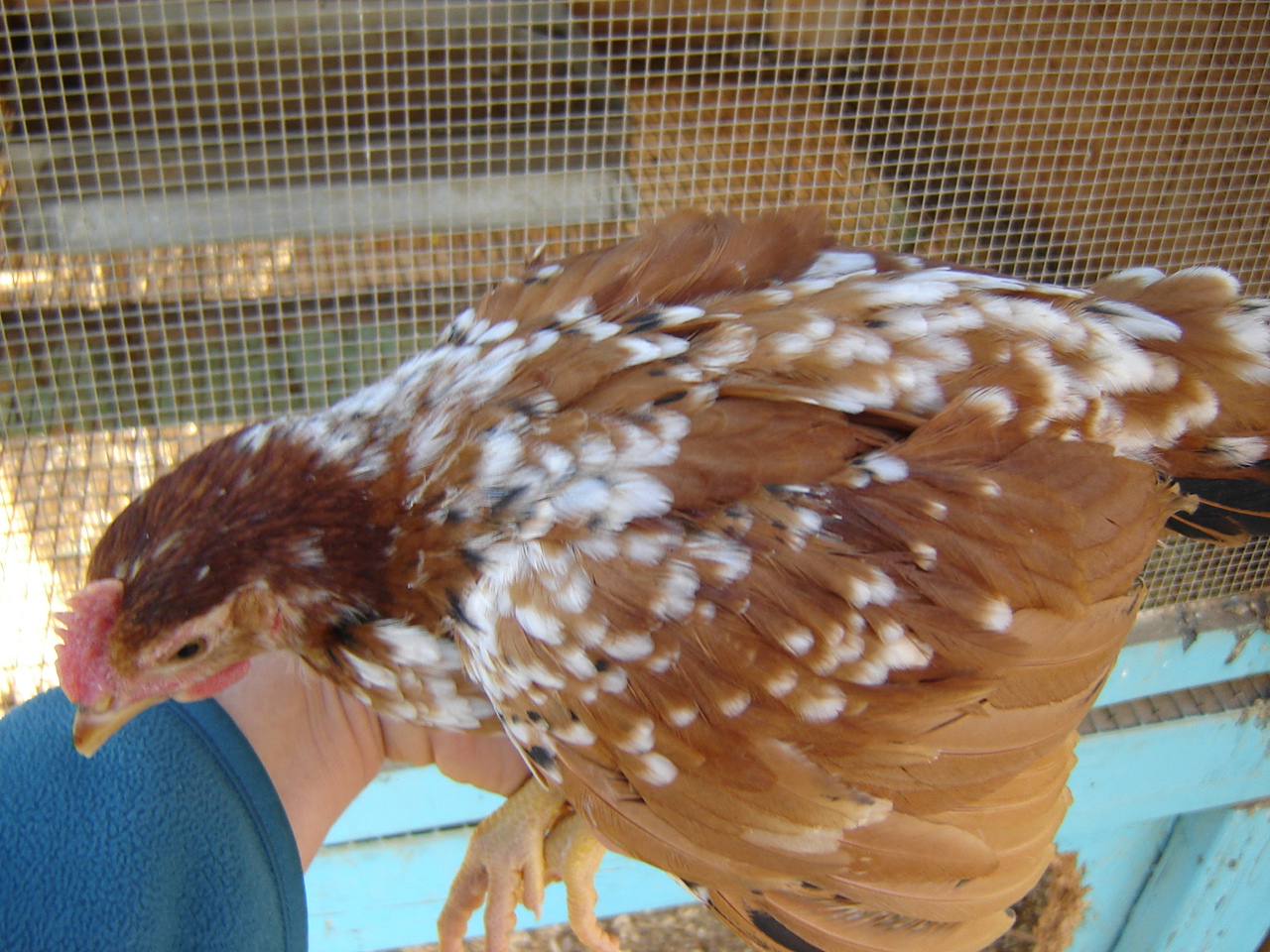
And here are photos of three of those babies that appear to be roosters:
Chick #1 (above and below)

Chick #2 (above and below)

Chick #3 (above and below)


Color?  Oh yeah, we got color!

There seems to be one hen chick with color, shown below:


The rest of Cheeto's chicks are mostly solid buff, but a few show tiny bits of white here and there.  Those teeny white specs very well may fade out as the chickens mature, but even if they fade, it clearly "marks" those chicks as carriers of the mottling gene.

Which leads me to the final comment of this post . . .

There were several half Buff Rock chicks that I hatched out last year.  Why did I pick Cheeto?

One day, I was feeding the chicks, who were about three months old at the time.  Cheeto moved his wing a little bit, and there on the very teeny tiny tip of ONE single feather was a trace of white.  I have never really found this feather again, by the way!  The amount of white was THAT small.  Just a trace!

I pounced on Cheeto, and immediately carried him to the house, and tagged his leg with a blue zip tie.  He carried that tag until adulthood, as he was identical in every other way to the several buff chicks I'd hatched from this cross.

A few years ago, I had a hen out of mottled dad, who was solid except for one white wing feather.  When I crossed her back to a mottled rooster, she gave me some of the most colorful chicks I'd ever seen!  So keep an eye out for "solid" chickens if you are breeding for Mottled color.

Check them carefully for clues that they carry the gene.  Here's an example of a hen that looks solid but is a mottled carrier.  See the white tip on the tail feathers?  It's the only white she has, but I'm sure her chicks will be quite colorful if she's bred to the right rooster!  Click on the photo below to make it larger, and look carefully at the very end of those tail feathers.

(There is just a teeny tip of white on a couple tail feathers on this girl.)

Color genetics are so much fun!

Wednesday, February 8, 2012

Update on the Fall 2011 Chicks

I've only managed to hatch out about 24 Alohas this fall, way less than my "normal" hatching schedule.  (Been traveling a lot!)  Four chicks were hatched out naturally when a hen took over and I didn't have the heart to break up her nest.  The other 20 or so chicks were hatched in an incubator, around Thanksgiving.

First up, the four October chicks!  Here's two of them shown at a month old:

Two of the four October chicks, at one month old.  
The chick in the background has since completely lost his spots.
He now appears solid buff!  
The other chick appears below.
The only one of the four October chicks that I'll be keeping to grow out.
He does have Barring, but his buff mottled color is very unique.

One of the buff mottled chicks has now actually lost his spots - very strange!  He now looks orange with one white wing feather.  He will be culled.  The most promising chick looked very bright red/white mottled, and was very large, but also shows lots of barring and puffy cheeks.  Not helpful.  The hen developed leg issues and was culled.

Which leaves this one baby rooster to grow out for a while.  He too shows barring, but the buff/white pattern has been hard to get:

Getting a nice Buff Mottled chicken has been very tricky.  I wonder why?

Next up - November chicks!  Some were by Cheeto, who was running in the "big pen" with Flame and two other roosters with mostly small Aloha hens, but also I added two large purebred Sussex hens.  So it was a big old mess in there, and I don't know who was with who, exactly.

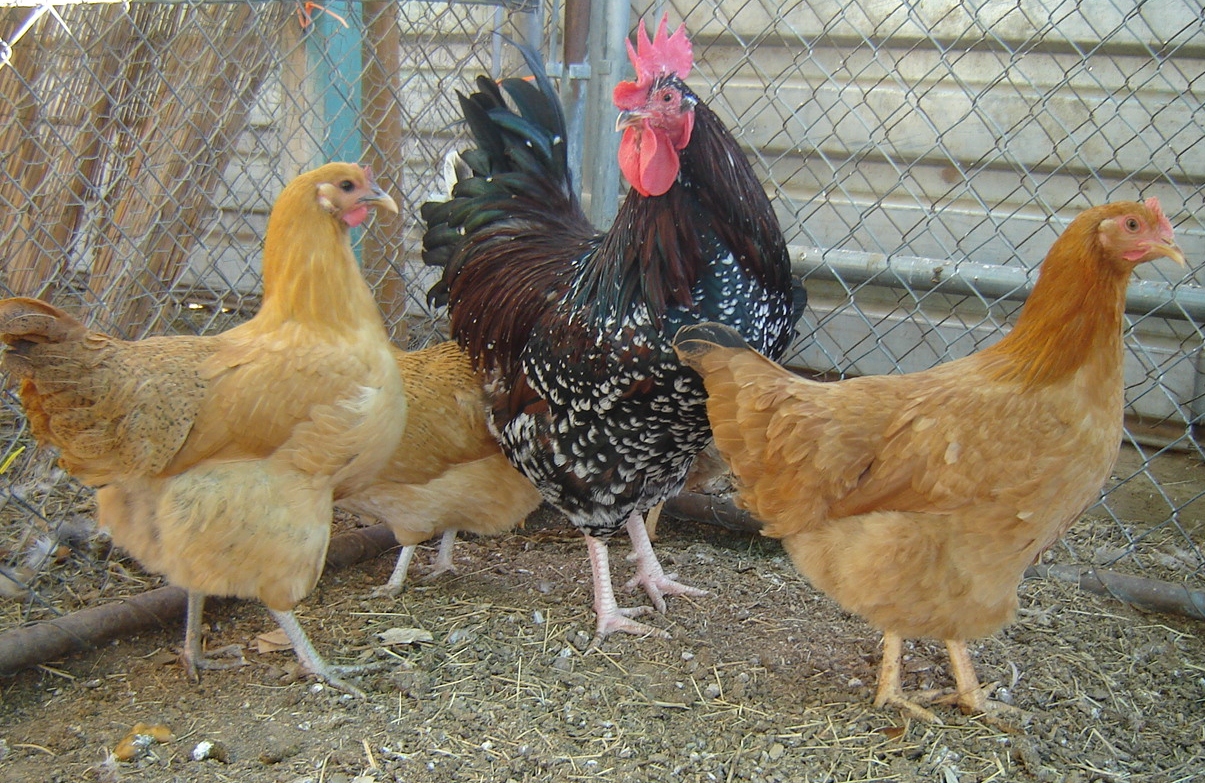
In the small breeder pen was a HUGE pure Sussex rooster with several big buff hens:


Some of these big yellow hens should have also carried the Mottling genes.  Overall, MANY of these chicks hatched were half Sussex - either their dad was this big Sussex rooster, or their moms were one of the two pure Sussex hens in the main pen.

What is surprising is how much many of these chicks resemble purebred Sussex!  I can't even tell the difference right now.  Can you?

Above and below - NOT pure Speckled Sussex.  Only half.  
But they look like "regular" Sussex to me???
Three are hens and will be kept.  I'm hoping some fun colors are hiding behind that boring brown-ness:
Check out the huge "Sussex" rooster on the bottom right.  He's half Aloha.

I may even keep one of the biggest flashiest Sussex-y roosters, just as a test.  There were absolutely NO Sussex-to-Sussex breedings in this pen!  All of these are only HALF Sussex.  What sort of colors are lurking behind the sea of dark mahogany?  Will all sorts of colors pop out next time?  Or is the Sussex mahogany color just that strong?

For those of you working with your own Aloha programs - this is why you need to introduce other breeds into the mix.  Sussex color is very dominant, so try to mix in some New Hampshire Red or Buff chickens to break this color up.  I have been reluctant to introduce a lot of Sussex blood into the program.  It needs to be added as a "dash" or else you end up with what looks like a really lousy flock of purebred Sussex.

Of the seven Buff chicks (probably sired by Cheeto) in the November hatch, several showed mottling at first, but like the previous October buff chick, the delicate mottling is simply fading away.  These buff roosters were re-homed.  Three of the chicks did show buff/white - but WAY too much white!  Those were also rehomed.

Too much white, or not a enough white, what a mess!  Nine buff and white chicks total.  Only the one guy shown HERE had the perfect mix of yellow and white:

Buff Mottled - only this fellow is the perfect blend.  
Everyone else was culled, too much white, or not enough.
Buff Mottled is proving to be a "tricky"color so far!

Many other chicks showed too much barring, all over.  Nice, but you have to watch the Barring gene, it can become dominant in a jiffy.  Use it sparingly!  Ha ha.  These will also be culled.

Beautiful!  Yet barred.  Lots and lots of Barred chicks in this group.
Another barred beauty that will be culled.  

Which leaves me with a few hens that look exactly like Sussex hens (but are really only half Sussex - so hopefully they will give me some new colors when bred to the right roosters.)  And one rooster who is a good mix of Buff and White, but sadly has the barring.  (I may cross him with the half Sussex hens?)  But he's the only decent yellow/white so far.  Besides the barring on the buff/white guy, he's also kind of small.

And last, there is this rooster:

The best rooster prospect so far.  Light brown, decent white, no barring so far.  
Good size.  Will see how he grows out.

This guy has gorgeous light brown color and white flecks.  Looks very promising!  Best of all, he looks NOTHING like a Speckled Sussex.  Ha ha!  It's pretty tough to make it into the Aloha program here!  If they're lucky - six chicks might make it into the breeding pen for next season.  Will update on the remaining roos and the few hens as they grow out.

More chicks in the brooder . . . more eggs in the incubator . . . here we go again!

Tuesday, February 7, 2012

Let's Get Hatching! (Again)

After a long delay, it's time to gear up for lots of hatching this spring!

I went out of town for the first three weeks of January, which meant I had to hold off on hatching out new chicks during that time.  Lucky for me, a friend of mine and fellow Aloha member, kept hatching in my place!  Larissa managed to get about 30 Aloha chicks.  They were partly from some of my eggs, plus some from her own Aloha breeding pen.  Yay!  So there are many New Year's chicks hatched and growing at Larissa's.  Will update with photos as hers develop.

Then she set two dozen eggs of mine, that I'd saved from a "special" breeding pen featuring Cheeto and a select group of four awesome girls.  The goal:  to scientifically determine once and for all, does Cheeto carry the recessive Mottling gene?

Above:  Fabulous Cheeto: 1/2 Buff Rock, 1/4 NHR, 1/4 Confetti Aloha.
But does he carry Mottling?

Well, the darn guy ended up only covering HALF the girls; because only 14 of the 24 eggs were fertile.  Ten were sterile and tossed out.  GRRRRR.  (A rooster should be able to handle up to 8 hens at a time, so covering only four hens should not have been an issue.)  This means my experiment isn't complete yet, as I don't know whose eggs developed and who was left out?  But it's a start.

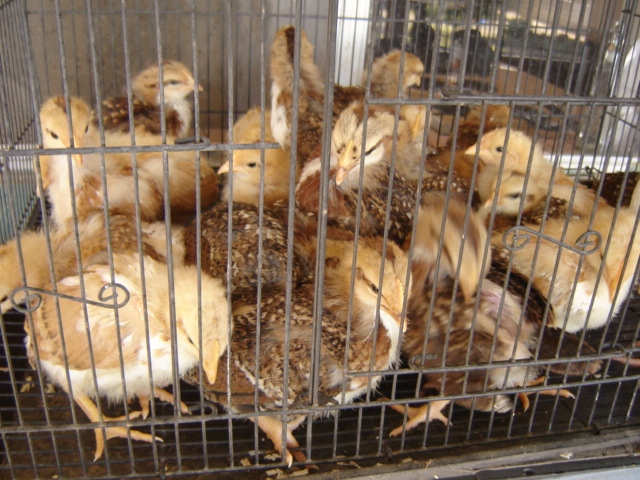
The result was 13 healthy chicks in various shades of buff and gold.  All of these are "for sure" carriers of bright colors - just look at the moms!  So even if these baby chicks don't show mottling when grown, I can safely keep any of the hens, knowing they will carry some fabulous color genes.  Even if they appear solid when grown.

The new chicks!  All of these are Cheeto's babies.  Some hens will be kept for the program.

Remember - Sussex-type Mottling is recessive.  It can disappear easily when you breed Mottled to Solid, but it should come back later when bred to another mottled carrier.

According to "theory" - if Cheeto is a mottled carrier, because these hens all show color, the babies should be half Mottled, half Solid in color.  About half would show visible spots on their chest, wings, or tail, though the number of spots or the size of those spots may vary.

If he does not carry Mottling, the chicks will all grow up to be solid in color.  (Though there may be a stray white feather tip or random single white feather that is a "tell" that the gene is there, in hiding.)

Either way, the hens from this cross should be bigger in size, light in color, and good layers, and great for the breeding program.  All hens will CARRY the genes for spots, even if they don't show it.

I'm bummed that the eggs were not ALL fertile, because I don't know if this batch includes the offspring from my two favorite hens!  All four of these hens are fabulous, but I especially like these two:

Hen with bold spangles - 1/2 Sussex 1/2 Aloha


Hen with light "mille" pattern - 1/4 Sussex, 1/4 NHR, 1/2 Aloha.

The other two hens are also lovely, but I have to see if I can get Cheeto's lighter base color onto these Sussex/Mille color patterns.  One of my goals is to get a true, gold/black/white Mille on a big chicken.  (Similar to a Mille D'Uccle Bantam.)  The two other hens are also great in color and body shape, but they are red and white - not the Mille "tri color" pattern, so I'll put them back in the main pen for a bit:

A third hen in Cheeto's pen - yellow legs, and red/white mottled color.  Only black is in her tail.

So my next step will be removing the two red/white hens, waiting for these remaining tri-color hens to lay a few eggs, and taking those eggs to Larissa to see if they end up "blanks".  (Though I have no idea what I'll do if they are blanks?  Play romantic music in the coop?  Rose petals on the coop floor?)

Will update with progress on the new batch of fuzzy yellow puffballs!  Wish I knew exactly which of these hens are the moms?  Crossing my fingers and HOPING for SPOTS!

Thursday, December 15, 2011

October Chicks Update - Six Weeks Old

Here are photos of four chicks that a hen snuck off and hatched all by herself in late October.  They look terrific.  Three look to be "Confetti" colored.  One is noticeably larger.  They are about six weeks old right now and fully feathered, but will probably still go through many color changes over the next few months.  Will update again later, hoping to see some size improvement. 

I probably can't say "for sure" that these are Cheeto's babies until they are fully grown - and if they are his, they should be MUCH bigger than a regular small Aloha hen.  They are very spirited, always moving, and hard to take good photos of.  But they are also extremely curious - running right up to the camera, then darting away!  These were the best photos I could manage, LOL.


Saturday, December 10, 2011

Update on Thanksgiving Chicks

New photos of the chicks hatched week of Thanksgiving, 2011.  Many are starting to show color.  Many look like pure Sussex chicks, which makes sense because I had a pure Sussex rooster in one pen, and two pure Sussex hens in the other pen with Cheeto.  So a lot of these chicks are half Sussex. 


Two look like they will be Gold Confetti.


A few look to have brighter, more reddish tones.  And size is much bigger on many of the chicks!  Temperament is also more calm and relaxed than previous generations.  Will update again in a couple of weeks, when they reach one month old.  They should have their full baby feathers at that point.


Cheeto's New Pen

Now that the Sussex rooster is at Stephen's, it's freed up a small pen for me to use.  I'm going to put "Cheeto" my big orange rooster in with four of my very favorite hens.  All of these hens have great spotting, great body shape, and are wonderful examples of what I'm working for.  Only problem is they are still not big enough.

The pen will be set up for about one month before I will try hatching out eggs.  This way, I can be sure that ONLY "Cheeto" will be the father of the chicks.  Then, I'll see if any of these develop spotting.  It would be the only way to see for sure if Cheeto carries the gene for Mottling. 

But now I'm counting my chickens before they hatch!  Here's photos of Cheeto and the hens I'll be putting into this special pen.  I'll definately be keeping some of these chicks for next year's breeding program.

This is Cheeto:


This is a light brown mottled hen with lots and lots of white and great body shape plus yellow legs:


This hen is almost a Mille Fleur color:


This hen has even small white speckles on a light brown coat.  Very little black:


This is her a couple of months ago, as a pullet, she's kind of camera-shy:


This hen is either full Sussex or half-Sussex, but I think she's half.  HUGE white blobs on her feathers:

Above:  Taken a few weeks ago.
Below:  Dec. 2011

This pen should definately produce some top-notch chicks.  Even if they don't show spots, with moms like these, I can be sure they will carry nice genes for wonderful mottling.  Although I certainly will be thrilled if spots develop on any of the chicks!  Stay tuned for the results! 

Chicks will not actually hatch from this breeder pen until mid-February at the earliest.  Then we'd have to wait a while after that to see if any actually develop color.  I can't wait to see what happens.