Tuesday, November 19, 2013

A Very Tough Summer For Humans (And Chickens)

There has been little reported here, through the summer, because, well, it's been a rough year.  I'm happy to report that I am doing well, and so are the chickens.  However, I have lost two good friends to cancer in the last six months.  It's been a tough thing to deal with.

Also lost were a few good chickens . . . with temps of up to 117 degrees, it's hardly surprising.  The summer in Phoenix is long, hot, and brutal.  My lovely big hen "Nui" passed, and so did Raymond's Roo.  Up at Stephen's, we lost the fabulous new Sussex roo that I was so happy to welcome.  There were a few others here or there, but in total, I am pretty certain it was less than 10 total lost, and possibly as few as six?  Some were youngsters here, and I'm afraid I lost track.  But it was never anything alarming, one every few weeks.

Plenty have been hatched as replacements. I kept about 50 chicks to raise up of my own, and have been busy culling away in waves as they matured.  I currently have about 25-35 adult hens and several roosters.

Right now I'm still organizing the breeder pens.  It's late in the year to do this, I should have been more on the ball.  However, my newest baby girls just started laying in October.  I have two Sussex hens that are due to begin laying in December.  I set up Stephen with a bumper crop of chicks (I think possibly as many as 70-80 babies?) and those are also due to begin laying in December or January.  So it will be Spring that we'll see the best progress.

Speaking of progress, looking at the photos from last April, I am beginning to see some some great steps forward.

Here is a photo of what I would most certainly call a "finished" Aloha:

About time!  Getting to the Aloha goals at last.
Note the overall body shape.  Deep keel, upright fan-shaped tail, yellow legs, upright single comb.  I will always, always welcome a bigger, fatter, body, but this is completely acceptable.  I believe, for her pedigree, she is half Swedish Flower hen, or possibly, her mom was Nui, who was Aloha with Sussex and Buff Orpington.  Both hens were crossed with Raymond's Roo.  Raymond's Roo was mostly Aloha with a good amount of Buff Rock and a lesser amount of New Hampshire Red, with the remainder "old school" gamey-type Aloha.  This hen would be about 25% old-blood Aloha, and about 75% "big chicken" of various breeds.


She is only six months old, has more white than her pure Swedish mother, and all Mottled chickens will shed out to show more white with each passing year.  I'd like to see more white overall, but this would be acceptable for the low end of the Aloha standards.  (In other words, this is about the minimum amount of white I'd want to see in an Aloha.)

Her size:  BIG.  As big as, or bigger than, hatchery Speckled Sussex.  No trace of Banty size or gamey type.


A shame that we lost Raymond's Roo, as this is obviously a cross I'd like to repeat to infinity . . .


Other hens that are "near misses"


  Beautiful, I love the not-mahogany but still dark brown color with the golden shadings in the neck.  Great body.  Terrific upright tail set.  The tail is fantastic and exactly what I had in mind for this breed if we can keep it.

Needs a lot more white, plus yellow legs to be an Aloha.  Still a "keeper" and I can't wait to see her chicks.  Heavy Swedish Flower influence.


Another nice big hen.  She needs more white but her light brown color is very neat.
I am seeing Swedish Flower but New Hampshire Red could also be present.

  Here she is with very first hen shown in the first photos above.  
Note the tail is more tapered, does not have the nice square "fan shape" of the hen behind her.
She has pink legs instead of yellow.  Very close, but the hen on left is better overall.  

This hen has Barring like her dad (Raymond's Roo") which is OK in moderation.  (Don't cross a barred chicken to another barred chicken, though.)  The tail could use some work, it is longer at the top and not as upright or fan-shaped. But still great size, plus yellow legs, will see how her chicks turn out!

Another shot of the Barred hen with a 100% Speckled Sussex for size comparison.
As you can see, she is BIG.  Her large size and light color are her best features.
Here is the brownish spotted hen shown above, alongside a hatchery purebred New Hampshire.
Size is good, but not as big.  Someday, I'd like to get Alohas as large as the New Hampshire which is why the NHR is in the breeding pen!  Her chicks will add size to future Alohas.

I also have three pure Speckled Sussex hens in this breeder pen.

This hen, "Sprinkles" is from Stromberg's Hatchery.
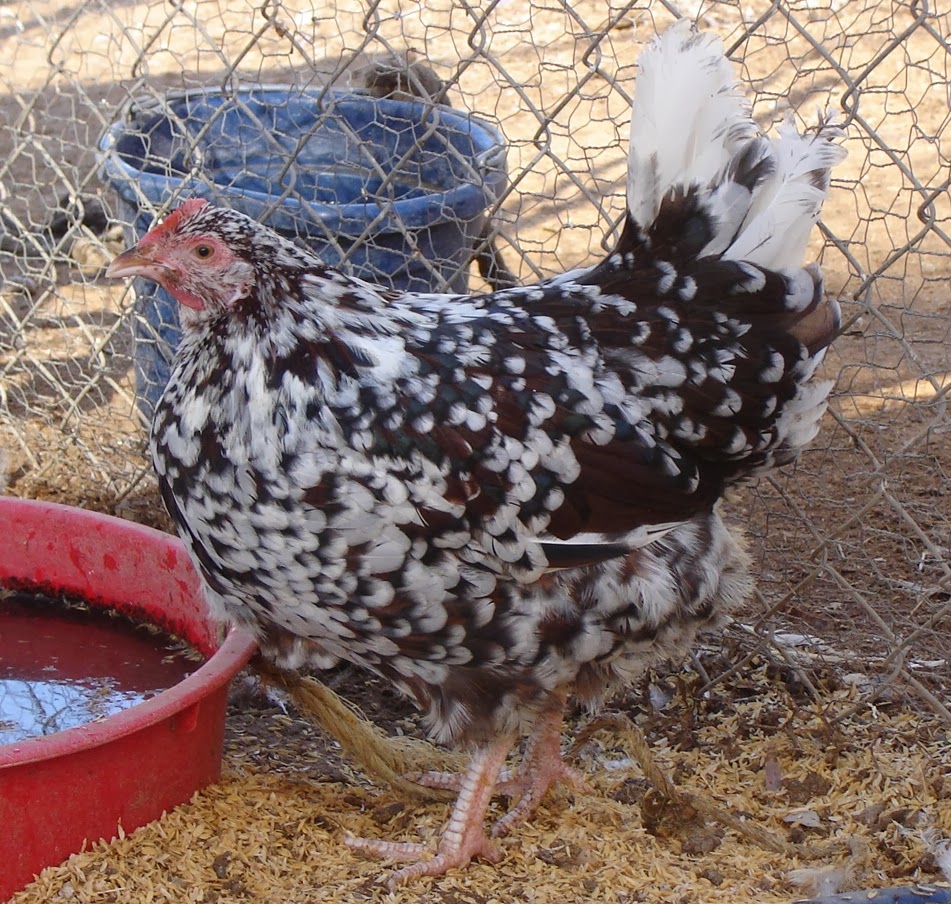
And this SPOTTY girl is from Ideal Hatchery in TX.
She is due to start laying in December.  Can you say SPOTS???
This is the amount of white that I'd like to see in all Alohas at five months old!

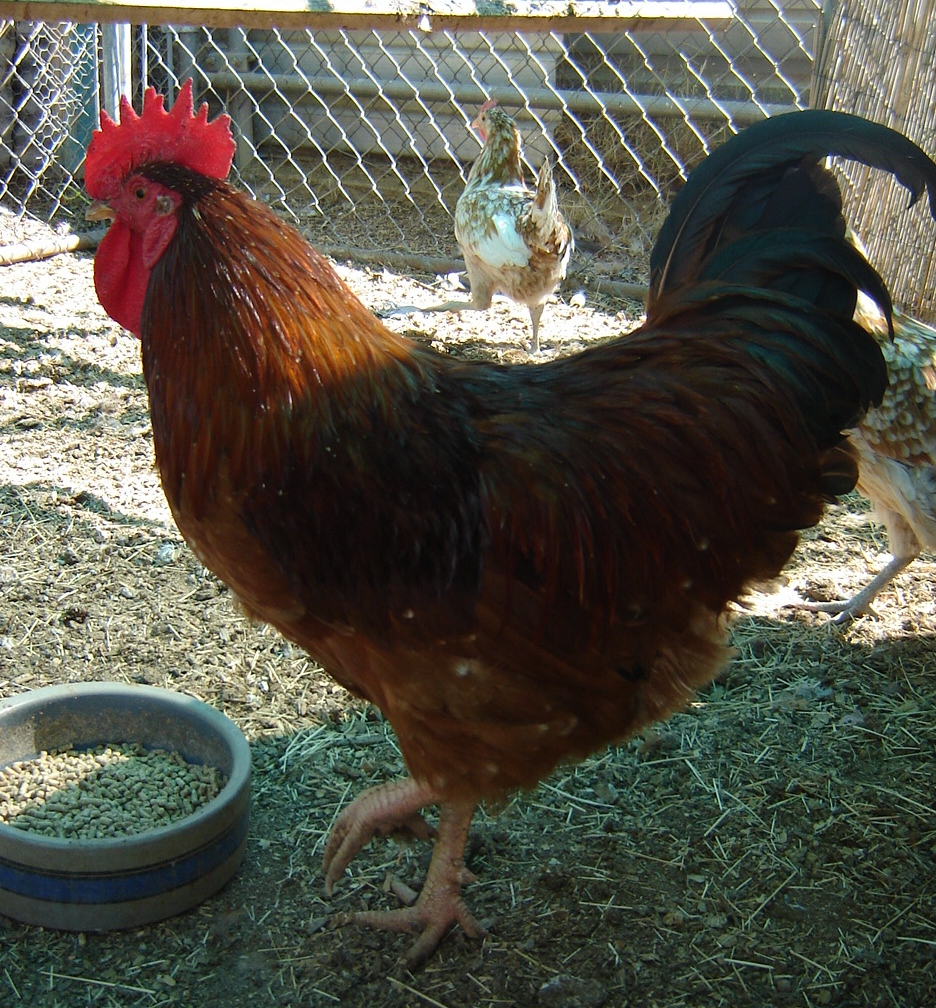
And finally, the rooster!  I had my eye on this flashy boy from six weeks onward!

He is a little bit smaller than a Sussex rooster, but not ridiculously small.
His size will "down" the size on the BIG hen's chicks - but not by much.
Tons of white, and lots of "ooh la la".  Which is to say, great shape and long tail!

I will be adding a few more hens to the pen, but that is pretty much going to be Breeder Pen #1 this season.  

Updates on Pen #2 and #3 to follow!


Saturday, April 13, 2013

Little Yellow Legs Babies

Here are the chicks from the Little Yellow Legs pen.  So far, they have exceeded all my expectations.

I keep reminding myself that chicks will change a lot in color so I'm trying not to get too excited.  After all, we had the color completely drop from the feathers of the "Cheeto" chicks who likewise looked very promising at this age.  But it is so difficult not to do the happy dance when you see something like this in your flock:


There are two like this, and both appear to be hens.  (You can see the second chick behind this one.)  Both have yellow legs and both contain ZERO Swedish Flower bloodline.  (Good in terms of extending the gene pool in the U.S. while keeping the Swedish "look".)  I only wish that I had hatched more of whatever these are.

Some other promising chicks:

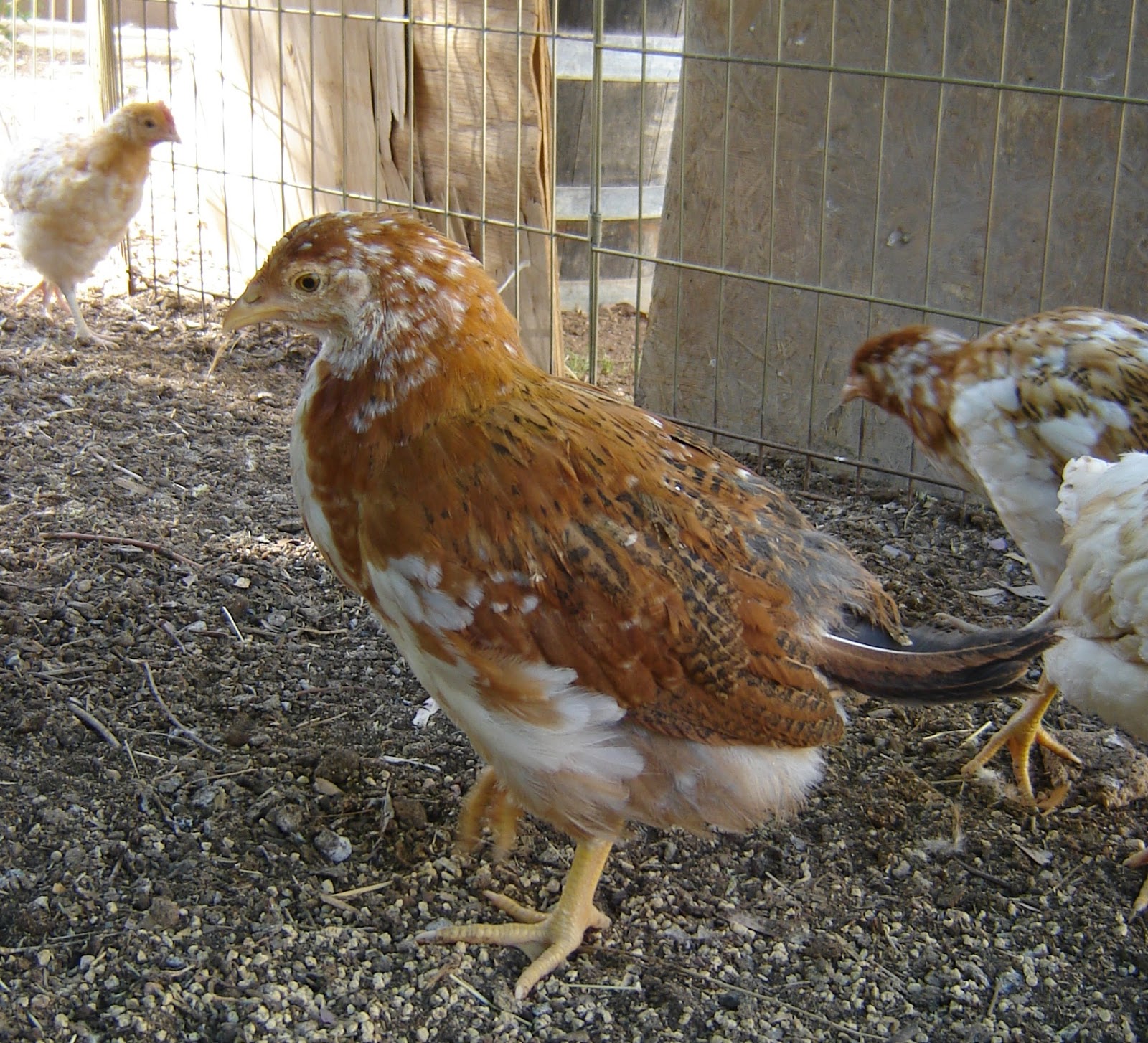
Not as much white on the above chick but she has fabulous light coloring.
This light brown chick has a large white chest and I wonder if she could color up later like a Sussex does?  Could this be a Sussex - without the dark Mahogany?  Also has the yellow legs I'm breeding for.

There is still much to learn about the Mottling gene.  Chicken color experts now say that the gene is the same whether it shows up in Sussex, Swedish, or Exchequer.  But here's the weird thing.  Sussex chicks start out solid dark brown on top, with white chests, and at four months the spots "spread" from the chest to the body, where they appear as tiny white dots on the feather tips.  Swedish chicks are born with tons of white all over, especially on the back.  But as they reach adulthood, a lot of the spotting just "falls off" the Swedish Flowers, and they are often left with just small white dots on some feathers.  And on Exchequer Leghorns, the babies start out looking like tiny penguins, with white undersides, black on the back.  The white spreads out around four months giving a 50/50 black and white "checkered" chicken.  The amount of white does not really change at all on Exchequers, it just kind of moves around on the body.

If this is all the same gene, why does it behave so differently?  Since my Alohas carry traces of all three of these breeds, plus an "unknown" Mottling factor from the Mexican stock, there is no way of telling how these chicks will eventually feather out.  The original Aloha stock, they would feather out with white on the back much like the Swedish Flower chicks.  However, unlike the Swedish, the foundation Alohas would not lose most of the color.  They would stay extremely spotted much like Exchequers.  It will be interesting, then, to see how this pen changes.  These chicks are mostly Aloha, but there is a bit of Sussex and a touch of Buff Rock from Cheeto's lines.  

And, while I told myself not to pick any roosters out from this batch, as they will surely be too small, of course there is the most adorable yellow-legged boy around.  Tons of white, and the most docile, friendly, and outgoing personality of all the chicks.  Zero aggression and pure curiosity.  I'm completely smitten with this little guy so far!


The last batch of chicks I raised, they dropped almost all their color at four months old.  So I will be watching this little rooster.  If he keeps a large amount of white to adulthood he may find a use here, despite his sure to be smaller size, by improving the amount of white spotting on chicks that are lacking color.  Not to mention the vibrant yellow legs he could help add to Sussex-bred hens.  Still much too early to tell.  But he sure is cute right now.

A lot of the chicks have a watercolor wash or "faded" look to them instead of clear distinct spotting.  Not a huge fan of that effect, so while lovely, I will cull any with that look.  I'm sure the hens will find nice homes with neighbors.

So that leaves about half of these as possible future members of the Aloha flock.  I see five or six that seem very promising, but we still have two more months to go before the final results are in.  Chicks will change dramatically between now and then.  Crossing my fingers that changes will be for the better.  I will continue to grow them out in this pen for two more weeks before culling anyone.


Sunday, January 27, 2013

Next Project Pen: Little Yellow Legs

Last breeding pen, I placed two sons of the beefy orange guy, "Cheeto" (who was Buff Rock, NHR, and Aloha) in with some colorful hens, to try and improve body type while adding spots.  This next project is all about yellow feet!  Sussex have white/pink legs, and as I've been introducing that bloodline, the legs have been steadily going that direction in my flock.  So, in this next pen, leg color is what I'll be focusing on.

This is the rooster I'll be using.  He's Aloha, very small for a rooster, but he does have a great stout, stocky, round body type.  And he has fabulous yellow legs!  I wish he was larger, for sure, but he's what I have to work with at the moment:


Sure, I'm small.  But aren't I a cute guy???
His ladies are a mix of "everything and the kitchen sink".  


In this pen, I have two half-Sussex hens, including my BIG girl, "Nui".  If this boy adds yellow legs to her big size, we'll be doing great.  The smaller half-Sussex hen has spots galore.  In a perfect world, we'd get babies from her that had tons of spots, and yellow legs to boot.

Nui, the largest Aloha  cross I've ever raised.
I also have three teeny very LIGHT "Confetti" color old-blood Alohas.  We will see ZERO improvement in size.  There will be tiny chicks from this cross!  The best we can hope for is super-colorful little hens with yellow legs, that maybe can be crossed with a larger roo, who could give them the size while they give their chicks some color.

This teeny white Confetti hen next to huge Nui shows size difference.
The rest of the hens are a little of everything in-between.  A "Ginger" hen.  My favorite "Mille" hen, who is small but already has yellow legs and great color.  This cross will be to (hopefully) simply make more just like her.  A larger hen, with patchy "pink and white" colors that is just odd and very cool.  Plus, one big brown mottled hen who is half Swedish Flower.  Maybe she'll add some size.  That's the only hen of Swedish breeding in this batch, which means the majority of this pen will result in All-American Alohas, that will be perfect to cross to pure or half Swedish.

I have no idea what is going to sync up well with this little rooster, so we're doing a bit everything.  Three dozen eggs collected so far, and still have a few days left.  Hoping for a nice big batch of chicks to raise, 30-35 chicks would be great, but honestly I kind of "overloaded" the roo with 9 hens so fertility might be a bit low.  (I just couldn't stop adding hens, so many to choose from!)


No roos will be kept from this cross, most likely - they will be too small.  But,  my original Aloha ladies are a couple of years old now, so it's time to think about breeding replacements for those hens, as their laying ability will surely drop next year.

If I did nothing more than replace a couple of my older gals with yellow-legged, nicely shaped daughters, it's still a step in the right direction improving body type and leg color.  (Size will continue to be an issue for a while, I fear!)  If this goes according to plan, we'll have newly hatched chicks in February.

Next, this roo will head up to Stephen's to run with some pure Speckled Sussex hens!  Hoping to hatch out some chicks from that pen later this Spring, and pick out only ones with yellow feet.  The Sussex will help improve size, as Stephen's pure Speckled Sussex ladies are nice and big.


Monday, December 31, 2012

Update: "Sons of Cheeto" Pen at 6-8 Weeks

Update on the "Sons of Cheeto" breeding pen!

A short update today!  About 40 chicks were hatched from eggs specially collected from the established October breeder pen.  This pen, highlighted in the October post, featured two sons of "Cheeto" (A Buff Rock cross x Aloha rooster) who was penned with some of my most colorful hens.

Of the 40(ish) chicks hatched from this pen, 12 chicks were culled and sold.  (The chicks showing the least amount of white feathering.)

Meanwhile, over at a partner's farm, he has been hatching all other chicks.  This includes some excess eggs from the same breeder pen, but also some chicks from a Swedish roo over Aloha hens.  He brought over the most spotted chicks that also showed yellow legs.

The result?  A really FABULOUS pen of babies that are growing out now!


Will keep you posted as they mature, to see if the color stays on them, or if it grows out at four months.  Body type looks good on all, combs look good, so anybody keeping *significant* color at 4+ months will be kept for the program.  Crossing my fingers!


Saturday, September 29, 2012

October Breeding Pen - Sons of Cheeto

It's cooling off here in AZ, and finally the hens are starting to pick up on laying.  There is no longer any danger of chicks dying in the extreme heat.  It's perfect chick weather, actually - right around 100 degrees during the day, and about 80 at night.

I just hatched out some chicks, including shipped large fowl eggs that contain the "Dun" gene.  It's a modifier that could add a new color to the Aloha project.  It turns black into a chocolate brown, or in two doses, turns the chocolate into a shade of khaki-tan.  It has no effect on red.

I hatched out a few random Aloha eggs, but since everyone was wandering everywhere and the breeder pens weren't properly set up, who knows what these chicks will grow up to look like?  I don't have high hopes for them, but I hated to raise only a handful of chicks because it's pretty much the same amount of work to raise 5 or 25 chicks.

I ended up with six Dun chicks, and about 10 baby Alohas.

Next, I set up a new breeder pen.  In this pen, I placed two sons of Cheeto in there.  One was a "fading spot" chick you may remember from an earlier post.  He was "Chick #3" in this post:

http://alohachickens.blogspot.com/2012/03/cheetos-pack-of-chicks.html

Today he looks drastically different!

Cheeto's Son, #3

I also had another chick born about one month later, that was also clearly Cheeto's son.  He never had the amount of white shown on this chick.  However, he is a Mottled carrier, and does have a couple of stray white feather-tips here and there to prove it.  He had such amazing presence, I had to give him a shot.  I've named this guy "Dragon" and he's stunning:

Cheeto's Son, "Dragon"
While the ideal setup would have #3 in one pen and Dragon in another, each with their own set of girls, at the moment I'm stuck with just one breeder pen.  Since these boys get along great together, and are half-brothers, I tossed them both in there with the hens.  I have no idea who is dominant because I've never seen them fight.

I have a friend who may be able to toss a kennel my way, and if that works out, I'll put Dragon in with the hens with the most white, and put #3 in with the Sussex-type hens and hens with nice big spots.  (Since #3 DOES have spots all over.  They are just teeny tiny almost invisible spots, ha ha ha!)

There are 14 eggs collected so far from this group.  I can't wait to see what hatches out next month!

Here are more photos of the breeder pen, showing various hens and the two boys:

Dragon and three "Ginger" hens.

Part Sussex hen with gorgeous mottling.

Dragon, two small hens, and Nui - a huge half Aloha, half Sussex 

Beautiful Ginger hen with OK size.  (Not the smallest.)

#3 with a smaller hen for size comparison.

Clearly the boys get along fine!

A group of colorful girls.


Sunday, August 19, 2012

The "Real Life" Aloha Chickens

Recently, I won a trip to Hawaii via an online sweepstakes.  (Really!  My cousin won a trip to the Bahamas years ago, too.  Many online sweepstakes are legit.)  I got to bring one person, and chose my sister.  I let her pick the island, and she chose Kauai, where I'd never been before.

Our stay was at the awesome Outrigger Kiahuna Plantation:

 http://www.outrigger.com/hotels-resorts/hawaiian-islands/kauai/outrigger-kiahuna-plantation

I'd stayed at their Keahou Beach Resort a few times in Kona, because that hotel is located next to BEST snorkel spot on the Big Island.  (And they give you a free full breakfast to boot.  This is major for Hawaii.  Food is pricey.  Unlimited bacon anywhere on the Big Island is a serious bonus.)

But that was on another island.  Like I said, this was my first visit to Kauai.  I didn't know what to expect.

Yes, this is the view from the room.
Our Kauai condo was gorgeous and overlooked a grassy lawn, dotted with palm trees.  Behind that was the ocean.  I'd read in the Kauai guidebook to expect lots of chickens, which had me kind of nervous because my sis is a VERY light sleeper.  While the sound of roosters is nothing but music to my ears, I understand that others may not share my affection.  Well, Outrigger must have a chicken-hunter on staff or something, because we only saw two chickens on the property the entire week.

Lots of flowers at the Outrigger Kiahuna, but no chickens.
Down the road a mile on Poipu Beach, it was another story.  Chickens everywhere!

A lovely dark hen and her chicks.  Poipu Beach, July 2012.
The funny thing is I gave my fledgling chicken breed the "Aloha" name because I thought their spotted coats in a rainbow of colors would (hopefully) look like the wildly colorful Aloha shirts worn in our lovely tropical state.

And yes, I had seen wild chickens, both on the Big Island and in Maui.  Here's a shot of some Maui beggars when I visited in 2011.   But none of these chickens were spotted or colorful, they were just the typical "wild" brown.  So it was chickens like these ones I'd seen before, that I thought of:

A proud mama hen in Maui, May 2011. 

Begging for treats at a Maui car rental outfit.

So imagine my surprise when I get to Kauai, and discover REAL Aloha chickens!  There was a variety of colors, and while most were solid, about one in ten was mottled.  Leg color varied, and was slate, pink/white, or yellow, often within the same flock.

Mottling on this hen is great camouflage.
This hen was in a nearby Botanical Garden.
Up in a tree in Poipu Beach - not the same hen.
My favorite hen was very bashful but you can really see the resemblance between her and my Ginger girls.  I would have snagged this little hen for my Aloha flock if I could!  Sorry for the poor photos, she wouldn't let me get too close.  But her color and level of mottling were just gorgeous:


Chosen by nature, these hardy chickens were tough, small, with upright fantails and excellent fliers.  Shockingly, they looked very much like the small Alohas running around my back yard!

A great vacation, and as a bonus, I ended up with lots of "chicken swag" because Kauai is very proud of their chickens.  I bought a chicken mug, chicken stickers for my car, and my boyfriend got a rooster t-shirt.  I also carried a bag of bread with me everywhere I went to feed the chickens.  (I especially loved the hens with tiny chicks in tow.)

So, unlike the mythical Chupacabra or Sasquatch, I now have proof that Aloha chickens are real.  There are colorful spotted chickens who live on a beautiful beach in Hawaii, where they frolic and play all day long. Who would have thought?

"KONA" - Foundation Aloha Hen, 2009.