Sunday, February 7, 2016

Bielefelder Alohas?

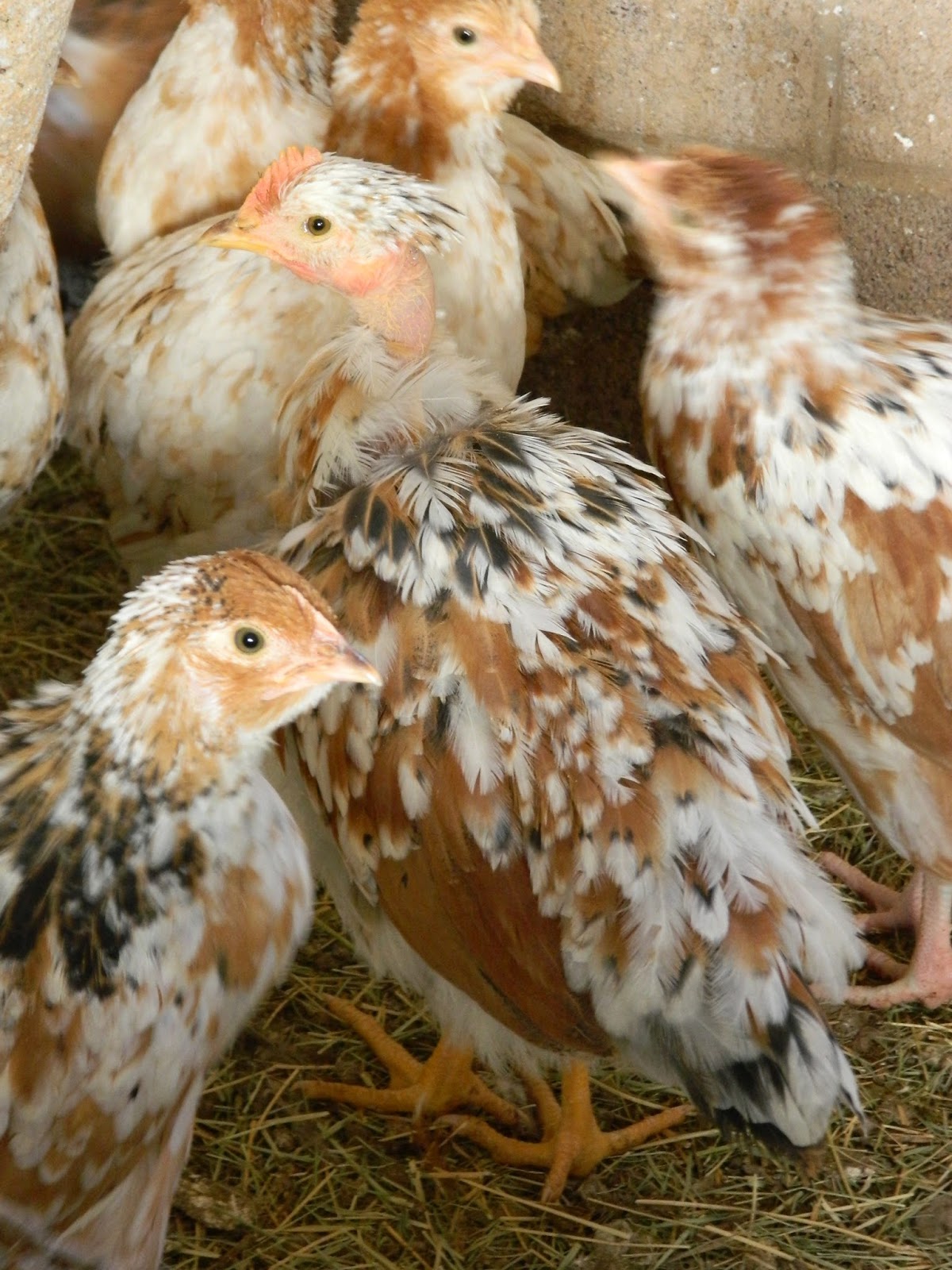
Recently, one of my Facebook friends, (who also has a few Aloha hens that she picked from me last year) posted photos of a pair of gorgeous roosters she was looking to re-home.  The roosters were both half "Bielefelder" which is a rare German breed, unheard of in the U.S. until Greenfire Farms imported them.

Marketed as the "German Uber-Chicken" the Bielefelder chickens have sold very well here in the USA, with Greenfire selling newborn females for $29 and males for $19 each, currently, as baby chicks.  They are supposedly terrific for both food and eggs.  Since I'm looking to make Alohas good dual-purpose farm chickens, these traits are exactly what I need in Alohas as well.

One rooster is a mix between Bielefelder and Rhode Island Red.  What is good about that, for my program, is I know through tests that the red color picks up spots with no problem.  (Unlike solid buff with buff tail chickens which would not show spots no matter how hard I tried.)


The other rooster is - most likely - half Aloha!  How about that?


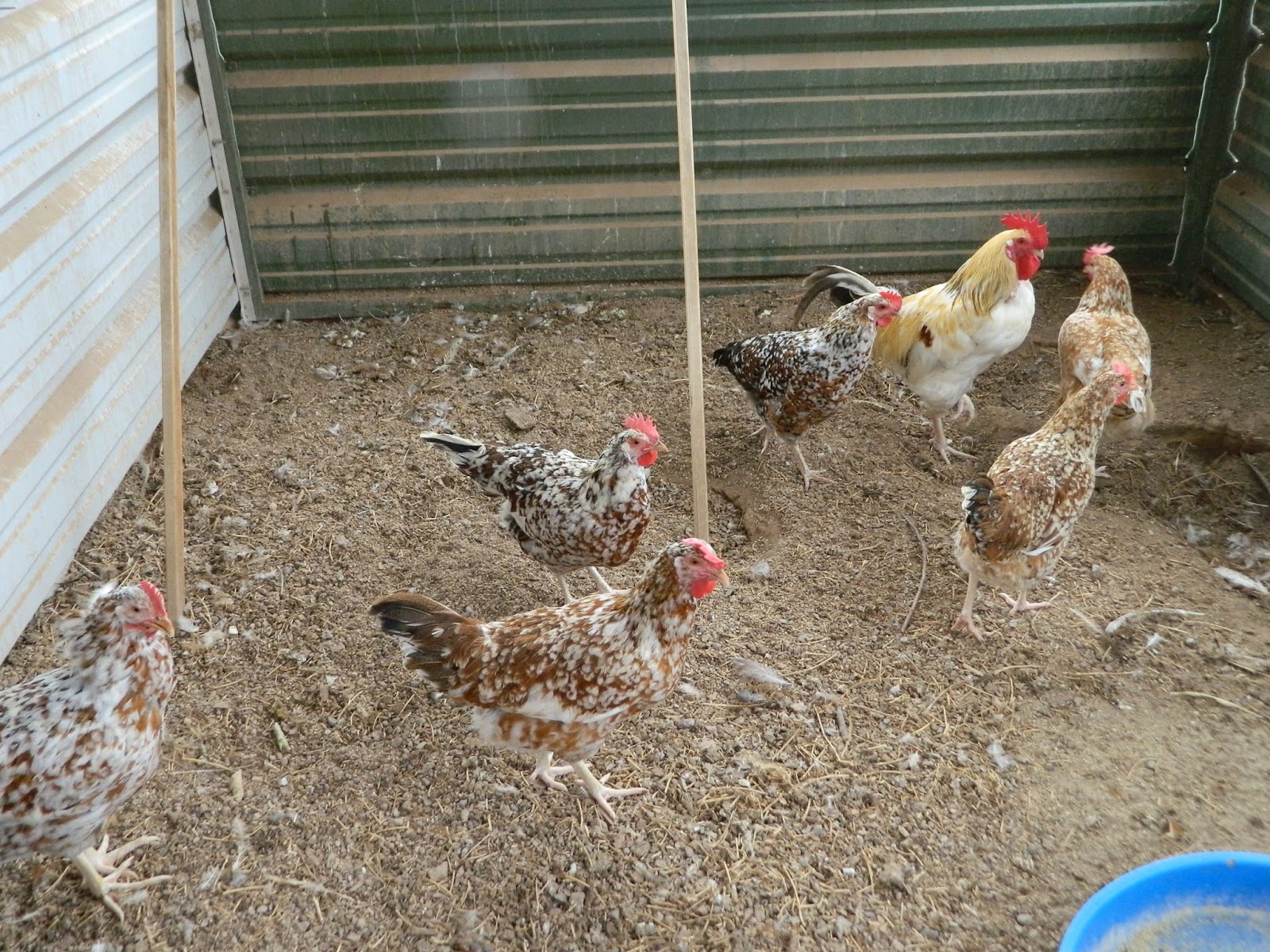
I put them in with a few hens with color that I love, but these girls really need a boost in size:


Now, the funny thing is, I've been avoiding Barred chickens, because I know that a Barred rooster can turn the whole flock Barred in one generation!  So it's not like I hate the color when Mottling is added, it's pretty, but it can "take over" a flock quickly, and soon that is the only color you will get, if you aren't careful.


I recently learned more about "auto sexing" breeds, however, and I think I know how to use these boys in the program effectively.  I will keep only the barred girls, who may or may not also have spots - it depends on which boy is the daddy, and whether he really is half Aloha and carries spotting?  Most likely the chicks will be solid red and barred, just like the Dads.

However, I have learned that if I keep only the Barred hens from this cross, and breed them to a rooster with no barring - let's say a Speckled Sussex rooster for example - the hens will not have barring, and the boys will all have barring.  At birth, the boys will have a light spot on the top of the heads and the girls will not.  In other words, if I keep the hens of this cross and pair them with the right boy, I could be able to sex the chicks at birth, and raise ONLY the hens!

Every hen from this next generation would have a 50/50 chance of being spotted if paired with a spotted Aloha rooster.  The result of that cross would be 1/4 Bielefelder hens, with spots.

The Bielefelder carries the gene for yellow legs, which makes them a great choice for pairing with the Aloha / Sussex crosses, to try and add the yellow leg gene.  The hens from this cross could go GREAT with roosters from "Big Orange Roo" or spotted sons from the Dun pen.

The size of these half Bielefelder boys?  HUGE.  I took my "Big Orange Rooster" over to their pen, to compare size.  I thought my Big Orange guy was big, but not compared to these new dudes.  These half Bielefelder boys are still at least two inches taller, and also carry more weight!

This guy has some serious drumsticks.
I have collected eggs, and unfortunately I'm short on breeder pens, so I loaned these guys to my neighbor.  So I'll only have a couple dozen eggs to hatch, right now, but all I need is about 4-6 hens from this cross.  Since I gave the boys to my neighbor, I should be able to borrow them back for future use.

I have only three breeder pens right now, which makes it difficult to work on all the projects that I need.  This was an unexpected diversion.  Eggs are sitting on my counter right now ready to go in the incubator.  Hopefully, we'll see how the chicks look in a few weeks?

The Bielefelder  breeder pen, February 2016.

Big Orange Roo

The rooster that I was MOST excited about this year, is this boy:


He's so big and beautiful!  Not an Aloha, he's actually a pure Sussex.  A mix of Buff Sussex and Speckled Sussex.  Technically, he is mottled.  He does have some spots.  However, they are very small dots of white.  Not the riot of crazy spots that I like to see on an Aloha!


What that means - genetically - is that if I put him with my spotted hens, every single chick of his will have spots.  Some will have less spotting, since Dad doesn't have a lot, but every chick will share some of his big size, so it's just a matter of hatching lots and lots and lots of chicks, looking for the biggest chicks with the most spots, and choosing those to keep.

It sounds so easy.

Unfortunately, my Big Orange Stud turned out to be a Big Orange Dud.  My rooster needs Viagra.  (So many jokes abound!)  After I took the Dun rooster out of the breeding pen, and replaced him with this big boy, the eggs slowly became . . . infertile.
Huge pile of infertile eggs, going into the trash.
The pen filled with my BEST girls!  All those eggs going to waste!

When you see the hens in there, you'll understand why I'm upset.  Here's a few:


Above and below:  Same hen.  Orange spotted.
This orange spotted hen is the best sized true Aloha to date.
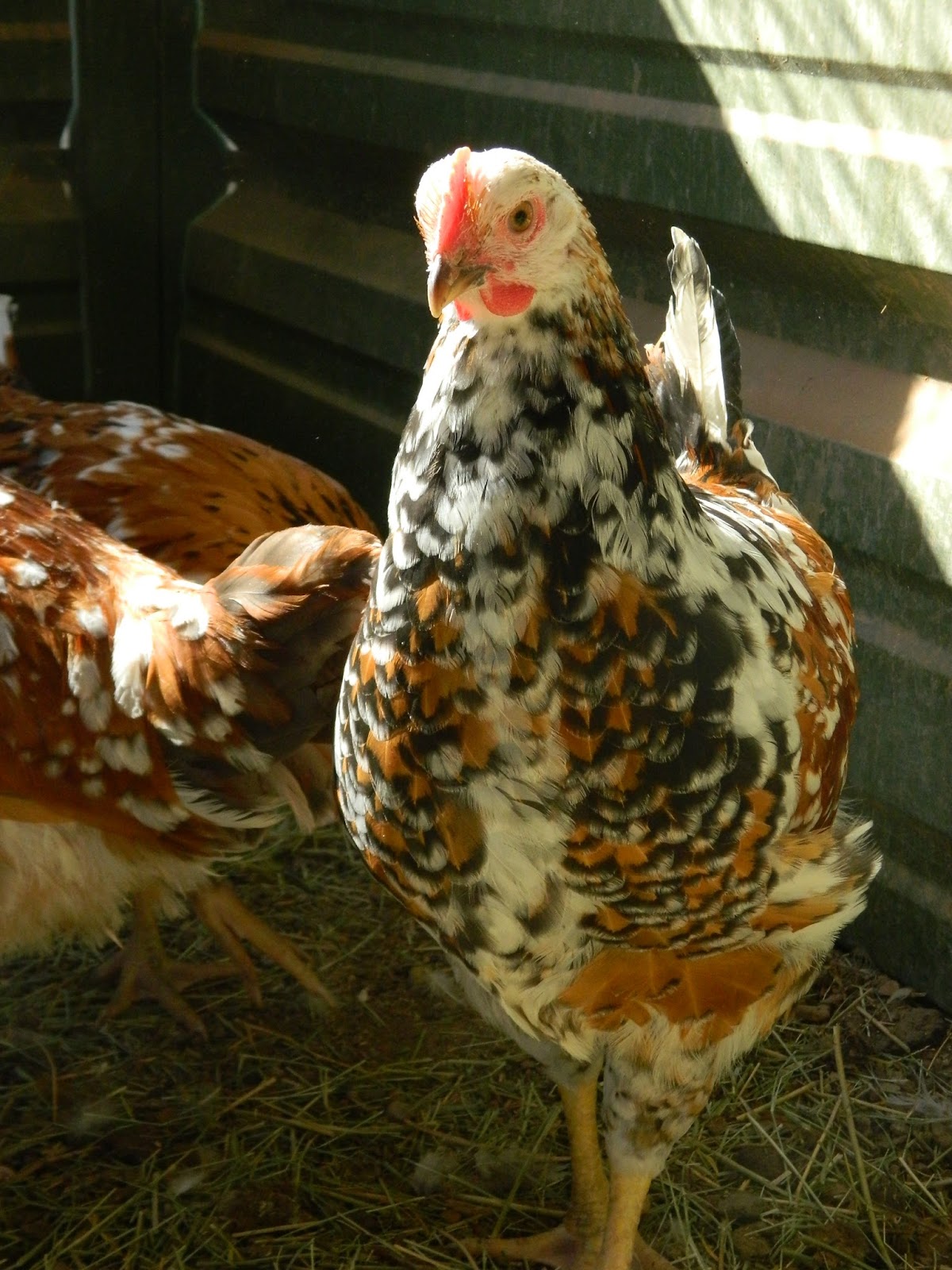
Pure Sussex hen - Buff with Mottling.
Aren't they pretty girls?  I'd love to have about 10 of each!

All of these hens shown are FULL size.  Not the small-ish "banty" size of many Alohas.

Here's a comparison for you:

Above:  Aloha hen with a (BIG) Buff Sussex hen.

Large Aloha on left, with small "mini me" Aloha on right.
Different "full size" Aloha on right.  Small Aloha hen on left.
I only have a handful of these "full size" Aloha hens with the perfect combo of size and spots.

The majority of my flock is smaller.  Bigger than Bantam - more like Leghorn size.

Well, it hasn't been a total loss.  There are a few eggs that are fertile - maybe one in 6 - so he is doing something.  At least, once in a while?

Here are some chicks that were hatched from the Big Orange Roo breeder pen:


There are a few other ones in there, a Naked Neck Aloha, and a few stragglers that still have the Dun boy as their daddy.  (Previous rooster's DNA can stay stored in the hen for up to one month.)  I could tell because a few of the chicks had the Dun rooster's white body color and that can't come from the Big Orange Roo.  But I can already see the chicks changing. from the Dun boy to the Orange roo.


Most noticeable difference?  The chicks by the Dun rooster all had yellow legs, and every chick by the new rooster has pink legs.  The pink color is dominant, so that's normal.  The surprise was how strong the yellow leg gene was in the Dun boy, that rooster did a great job on adding yellow legs to his babies.  Also, lots of orange and peachy colors in these new chicks!

(Above and Below) This cute thing has both
yellow legs and Dun color - probably by Dun Roo.

This lovely chick could be by Dun roo.  Shows promise.
I have managed to hatch even more chicks from that Big Orange Roo pen - these younger chicks have some by him in here, but also some by the Dun rooster, still:


Still too early to tell colors, really?  A few show real promise.  A few are still by Dun rooster.

And then there is this batch, which also includes a lot of Naked Neck or Turken Alohas:


Plus, there are 25+ eggs that are still in development in the incubator, due on February 13th!

So it's not a complete disaster, just a minor setback.  The 25+ eggs should all be by Orange guy.

New plan:  Put this orange dude in with a FEW hens - small girls with lots of white - but keep the number to only 3 or 4 hens, tops.  Keep the hen chicks with the most white spotting.  Maybe the smaller hens will be less intimidating for him?

Put the big Dun rooster in with my biggest and best girls, and keep anything with spots.  In my test hatch, that was only about 1 in 5 chicks.  I'd pick my future boys from the Dun boy's pen - where my very few girls with both size AND color are kept.  That would give me the best odds of increasing size in the next generation.

I have a good amount of chicks to raise.  Will be exciting to see their colors!


Thursday, February 4, 2016

Dun Project Update - Part 2

It's been a month since I updated with new photos of the Dun project.

To refresh, I took a huge, fast-growing Light Sussex / Aloha cross rooster, who carries Dun, and I put him in a breeder pen with 6 of my biggest and best Aloha hens.  Rooster's color was totally wrong.  It was hoped that I could "pull" out the recessive spots.

The dad to this group.  Right body, wrong color.
October 2015:  Breeder pen.  Above rooster with large colorful hens.
It worked, and out of 21 chicks, 4 were spotted.

Here was one of the boys last month:


And here he is now!
SON of the big White/Dun Rooster
Here is his brother:

Slightly smaller, but still large.  Dun carrier.
Most of the not-spotted chicks were re-homed.  However, I kept three light brown roosters with Dun tail feathers to grow out, just in case:

Growing the boys out - just in case.
Tiny white spots can be seen here, plus Dun.
I also kept one of the chicks that was colored more like Dad - for no good reason really?  She was just adorable.  If I don't keep her, I know of a friend who would love to have this chick in her flock!

About half of the 21 chicks were this color.
I'm VERY impressed with these chicks.  It really is a lot of work to hatch and raise 21 chicks, just to pick out a few spotted ones.  However, all of the chicks have been FAST growing - like the Dad - with yellow legs.

I am so glad I took a risk and kept the father of this batch, who showed totally wrong color but had traits like fast growth and terrific size, that I wanted to pass onto my flock.

Right now, the biggest male chick, is almost as big as my smallest full grown Aloha hens!  And he was hatched November 17th, which means he's not even a full 3 months old!  He will continue to grow at least until 5 months of age.

Largest mottled rooster from hatch.
What has been even more amazing is their personalities.  They are curious, and friendly, climbing all over my shoes when I go in to feed.  If I crouch down to take photos, one hen loves to perch on my shoulder.  They are cuddly, friendly, adorable, fast growing, and colorful - all the traits I was hoping to get in this breed.

The shoulder-perching chick
Orange-motted hen on ground didn't care to move!
Fearless towards humans, so friendly!
Meanwhile, I "broke up" this pen, after I hatched this group, so I could try my next cross.  I put the Big Orange Rooster in with the hens, but the orange rooster had fertility issues, (next post will be about that) so it looks like the Dun boy will go back in with my favorite hens.  We are going to repeat this project.  It will take a LOT of work to raise these chicks only to pick out the spotted ones.

However, the chicks that have been re-homed that were simply the wrong color have been a hit with their new owners!  I guess a good chicken is never a bad color.  Now that I've seen the results, I can sell the "solid color" chicks to new homes, confident the owners will get great chicks, even if they aren't spotted.

Very excited to get my Dun boy in the pen again.  It will take about 3 weeks to get his DNA back into the hens, and three more weeks to incubate those eggs - so we are talking mid March before we see new chicks hatching from this cross again?  That will still give me about two months to hatch lots of his "kids" and raise them, trying to pick out only the spotted ones, before the summer heat kicks in.

By May, the roos from this Nov. 17th hatch will be old enough to breed, and Dad will be replaced by the sons.  I'll be able to eeek out one last group of chicks by late May into early June, who can be raised over the summer and we'll try to "lock in" the wonderful traits I'm getting in this new strain.

Roo in front - Turken hens behind are adults!
Tremendous size for under 3 months old. 
I feel like FINALLY the Aloha chicken project is coming to a close - and now it will be a matter of standardizing the "project" into a finalized breed.

Sunday, January 3, 2016

Dun Project Update

Just a short post to show the growth and changes to date on the Dun project pen!

Group pics of the babies, now six weeks old:

Above: Check out the Dun Calico chick on the far left!

The rooster was this BIG guy, who was huge and fast growing, with yellow legs (good) but was the white color with darker neck band, which is totally wrong body color for the Aloha project.

Dad: Wrong color, great type.  Light Sussex breeding.

Below:  Rooster with the "Moms" - big Spotty hens!
Goal of this breeding pen:  Get the "right" color on his kids!

21 chicks were hatched.

6 chicks were white with some black markings. (Wrong color.)

6 chicks were white with some Dun markings.  (Wrong color.)

5 chicks were Buff with some mottling.  Not the "right" color but good for breeding stock.

4 chicks ended up spotted!  (Mottled color.)

Mottled chick showing LOTS of white.
Mottled chick with white chest.
Small Mottled chick with white chest.
That is a LOT of work to get a handful of spotted chicks, but I'm very happy with the few Mottled babies that I did get.  I hatched out several more from this Dun pen and another nice breeder pen, and even more eggs are in the incubator now.  But, these new chicks will be mixed from another breeding pens, so this will be our only "pure test" of just this rooster's chicks exclusively.

Unfortunately, I don't have enough pens to keep test batches separate.  From here on out, I will raise batches of chicks and look for the best chicks in the batch, although I may not know exactly who the dad of each baby chick is.  It's nice that I had a chance to try it on this batch of chicks.  It is a lot of fun to see how different all these chicks can be, even with the same rooster!

Bonus:  Most of the chicks do have Dad's yellow legs.

Colors will change a lot as the chicks grow.  We won't know final size for many months. Generally, the size and colors on baby chicks stabilize around four months old, which would be middle of March.  They continue to "fill out" for two months after.  Most chickens are fully mature between 5-7 months of age.

I kept all of the Mottled chicks, all of the Buff chicks (several carry Dun) and one white chick with Dun pattern - who probably won't be very helpful but was too adorable to re-home.  The rest of the chicks that were white with either Dun or Black patterning have been re-homed with friends of the Aloha project.  (I am keeping track of where they went to.)

The babies should be mature and ready to breed by May 2016.

Tuesday, December 1, 2015

A Tale Of Blue Chickies

Quick warning, this post is going to cover some genetics stuff.  I hope to present it to you in an easy to understand way!

This post is about these cute chicks, and why I bred them.  
This post is about the color "blue".  Well, not blue like the sky.  It's actually about many shades of gray!  No, not that 50 shades book - we're talking science, genetics, and animal colors today!

It's common in the animal world to call gray animals "blue" - like "Blue Russian" cats or a "Blue Kerry Terrier" dog.  The same is done in chickens, you'll hear of "Blue Ameraucanas" for example.

Here is a great Blog post on the "Blue" color in dogs:

http://caninebreeds.bulldoginformation.com/blue-dogs.html

Here is a great PDF on "Blue" and "Cream" (Dilute black and dilute red) in cats:

http://kids.cfa.org/understanding-cat-colors.pdf

So, as you can see, whether the animal is a dog or a cat or a horse or a chicken, there are different genes that make Red color in animals, lighten up to a golden tan or yellowish color.  There are other genes that make a black color lighten up to a chocolate brown or grayish color.

These different genes are often called Dilutes.  These "dilution" genes take a deep rich color - like black - and lighten it to a softer pastel shade.  How they work can vary, depending on the gene.

Picture a cup of deep. dark rich black coffee.  Next to the coffee, you have a little container of cream.  If you add cream to the coffee, it turns a lighter color.  That's the effect that "Dilute" genes have on animal fur.

Some genes can only give the coffee one dose of creamer.  It doesn't matter how much more you add, the color stays exactly the same!  (The chicken color "Lavender" works like this.)

With other genes, the effect can be doubled up, if both parents carry the gene.  That would be like having two people each with a little container of cream.  Imagine that the first person pours cream into the coffee cup.  That is like one parent animal giving the "dilution" gene to the offspring.  If the other person *also* adds their cup of creamer to the coffee, then the coffee gets even lighter still!  It just depends on the gene, and how it works, if it can be "doubled up".  (The chicken colors Blue and Dun work this way!)

There are many kind of "dilute" genes that can affect an animal's color, and each gene is different, though sometimes the general look is kind of the same.  A great example, in horses, is Palomino versus Champagne.  A lot of you know what a Palomino horse is, it's a golden horse with a white mane and tail.  Think of Roy Roger's horse, "Trigger".  Well, for years, people who owned Saddlebred horses or Tennessee Walking Horses, would sometimes get a Palomino with funny gold or greenish eyes.  They thought it was just a strange Palomino.  It turns out that was a totally different gene, called "Champagne"!

When you get a Champagne and a Palomino horse side by side, you might think they were all Palomino.  In this way, colors in animals can get very confusing.  Sometimes, what makes an animal appear a certain color - like gold or gray - can be totally different genes at work.

Here's a page where it shows a Champagne horse and a Palomino horse side by side.  The Champagne is a little more shiny, and has lighter skin, but overall, can see how similar they are?

 http://www.chboa.com/comparisons/goldvpalomino.html

About 15 years ago, DNA color tests became easily available for horses, and this has cleared up a lot of confusion!  But there are still no color DNA tests for chickens, so we still have to muddle through the old fashioned way.

Years ago, when I started my breeding project, people would  often share with me photos of a white chicken with bits of black or gray feathers, and say "Hey!  I found the perfect chicken for you to use!"  Often, the chicken would look like this one:

This is a BLACK chicken.  Really!
But WAIT.  That's not a white chicken with gray spots.  Genetically, that's a black chicken.

Yes, BLACK.

SOLID BLACK.

You see, in chickens, there is a color called "Blue".  If one parent is blue (fancy name for gray) and the other parent is black, half the chicks will be blue, and half the chicks will be black.  It's a simple dominant gene.  If a parent has the Blue color, half the chicks will have it, and half won't!  How easy is that, right?

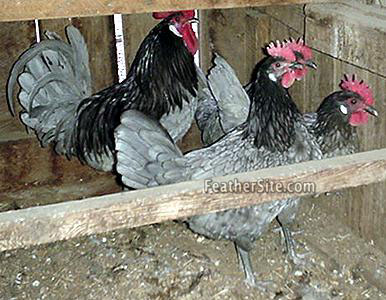
Here is a flock of Blue Andalusians:
The "spotted" rooster above, had parents like this!  Solid blue!
OK, so we know that if one parent is black, and one blue, half the chicks will have it, and half won't.  What if both parents have "Blue"?

Well, in that case, half the chicks will be blue.  One quarter of the chicks will be Black.  And one quarter of the chicks will get a "double dose" of blue - one gene from each parent - and those chicks will be a color called SPLASH.

This is a SPLASH Orpington:

BLACK chicken + Blue + Blue = Splash.
Bred to a black rooster, all chicks will be BLUE.
That's a solid black chicken, with two copies of the "Blue" dilution gene!  If she was put in with a Black Orpington rooster, all her chicks would look like this:

Again, Splash + Black = Blue.  This is Blue.
No, really.  ALL OF THEM.  They would all be solid gray in color!  That's how Blue works.

No blue:  Feathers are black.
One copy of blue:  Feathers are gray (or "blue)
Two copies of blue:  A color called "Splash" which is two copies of the Blue gene.

Anyway, you can see how when I'm trying to breed for spots, how having "Splash" chicks could really make this kind of confusing.  How would I know if I bred a nice spotty hen, or just a Splash hen?  So, I bred out Blue from all my Aloha chickens several years ago.

But, I like the look of Blue, so I wanted to have something kind of like that effect.  There are other genes that look similar to Blue.  Remember the example that I listed above - where I showed you how a "Palomino" horse could look almost exactly the same as a "Champagne" horse?  There is a reason I shared that!  There are other genes that make gray feathers on chickens.  These different genes, they don't make Splash.

So I decided to look at these other color genes!  One is called "LAVENDER" and is seen in Lavender Orpingtons, which are super popular and very expensive right now!  Lavender looks almost like blue, but it's a touch lighter and almost "silvery" in color.

This is LAVENDER, not Blue.  They look almost the same.
Totally different genes.  You will never get "Splash" here.
Lavender is a RECESSIVE gene.  So here's how it works:

Lavender to black:  All chicks are BLACK.  The gene goes into hiding!  You don't know who has it.  It won't show up until the next generation.  Then, the chicks must get a copy from both parents.  If they do, they will be "Lavender" and if you breed Lavender to Lavender, you get all Lavender.  So let's recap:

No Lavender:  Feathers are black.
One copy of Lavender:  Feathers are black.
Two copies of Lavender:  Feathers are Lavender.  (Pale blue)

Of course this would work well with Alohas as Lavender would not look like Splash, and there would be no confusion there.  True breeding, you get 100% Lavender chicks when both parents are Lavender.  That's handy!  No Splash!

But, how would I ever tell if a chicken was carrying Lavender?  What if I wanted to breed it out?  There would be no easy way, as recessive genes can "hide".  Better play it safe!

That left one other gene to play with:  DUN.

Dun in chickens makes a color a lot like "Blue".  It's a grayish color, but a little more brown-ish.  Some people call it "chocolate" but that's not a good idea to use that name, because there is another gene in chickens that is also called "chocolate".  Calling it "Dun" keeps things straight.  Dun is very rare in chickens, and it's only found in a few breeds, so you don't see it nearly as often as Blue.

Let's go over how Dun works.  Like Blue, Dun is a simple dominant gene.  That means, it doesn't go into hiding, like Lavender does.  If a chicken has Dun, you can see it!  It is there, or it is not!  Right in plain sight.  That comes in handy if you want to breed for it, or if you want to take it away, as you can see with your own eyes who has it, and who doesn't.

Dun only affects (or lightens) the color BLACK.  Dun, Blue, and Lavender - all three of these genes do not change the colors Red or Buff.  They leave those colors totally alone!

If Dun is crossed with Black, the chicks will be half Black, half Dun.

If Dun is crossed to Dun, half the chicks will be Dun, one quarter will be Black, and the last quarter will be Khaki.  The color "Khaki" is just what it sounds like - a sort of cool beige color.  It is to Dun what Splash is to Blue.

So in theory, if I had a flock of Dun Mottled Alohas and bred them together, I could get THREE different spotty chickens!  Chickens with "regular" black feathers, chickens with smoky chocolate brown "Dun" feathers, and chickens with beige or Khaki feathers!  And no confusing Splash chickens.  I decided that this "trifecta" of color possibilities was exactly what I wanted in Alohas.

Now, where to find Dun?  It's really hard to locate, as so few breeds have it!  I found it in a project that another breeder was working on called "Cinnamon Sussex".  He took the Light Sussex black neck and replaced it with Dun!  Okay, that white body color, not what I need!  But the size on these chickens was HUGE and they did carry Dun, so I ordered the eggs, over two years ago.

Here is info on Cinnamon Sussex:

http://cinnamonsussex.blogspot.com/

I took the GINORMOUS rooster with Dun and bred him to tiny spotty Aloha hens:


I kept one of the chicks, who grew to be an odd colored hen who carries both Dun and Mottling:


I also have a Cinnamon Sussex hen. She is gorgeous and big:


I have two Buff Sussex / Cinnamon Sussex cross hens, who now have the white color of the Cinnamon Sussex, replaced with Buff:

(notice the neck and tail feathers are grayish)
And I have another hen who should be carrying Mottling, out of these hens.  This means half of her chicks may be spotted, if she is bred to a spotty rooster:


So we are creeping ever closer to Dun Mottled Alohas!  The above examples show how the Dun color looks "pretty much" like Blue.  However, I will never get a "Splash" chick from these hens.

I set up a breeder pen in October, with this big boy. I believe his Mom was my huge Dun Sussex hen.  This rooster grew twice as fast, and twice as WIDE as his rooster siblings.  His body color is all wrong, but he has wonderful body type:

Isn't he a chunk?
I have put him in a breeder pen with some of my LARGEST and most spotty Aloha hens:


And now, I have chicks!  Some show Dun color, though I'm not sure if any will also show spots:

Without Dun, the wing would have black patterning.
Remember Dun has no effect on red or gold colors, only black.
Compare the chicks above WITH DUN - to chicks below with BLACK feathers - no dun!

Dun can't hide. Sibling chick by same rooster, no Dun.
NO DUN - Black feathering.  Sibling to above chicks.
To date, the only chick I've hatched with both Dun and Spotting belongs to a neighbor:

Dun turns black to a grayish color, but doesn't affect Buff or Red.
You can see the Dun where her neck feathers should be black?

Here, check this out - this is her sister, without Dun:

Buff mottled, with black neck and tail feathers.
See the difference?  Dun makes the neck feathers gray-ish.  Without Dun, the neck feathers are Black.  The really neat thing is, wondering, what will this color look like on a chicken with more black scattered all over the body?  It's really hard to see the effect on mostly red or gold chickens.  You need a lot of black to get the most dramatic look.

Here is a hen, that is currently in with my Dun gene rooster:

Try to imagine all the black feathers as silvery gray!
For now, we have to use our imagination to try and guess what that color would look like on an Aloha.  However, I have seen this color on a forum!  This is from Backyard Chickens member "Henk69" who lives in the Netherlands.  This chicken is a Bantam (Miniature Chicken) but shows what the Aloha breed, with Dun, might possibly look like in color:

NOT MY PHOTO - user "Henk69" from BYC.
Hen located in the Netherlands.  Dun Mottled Bantam.
As for two doses of the Dun color - which makes "Khaki"?  Well, that will remain a mystery for a while!  (Try to picture the black or dun colors replaced with beige.)  Replacing the Blue color with Dun, and having the possibility of Khaki Mottled is yet another way I hope to distinguish the Aloha breed from the Swedish Flower breed.

I will be keeping the Dun chicks from this batch, and updating as they grow!  I also have a second batch of these babies in the incubator now.  Stay tuned for more photos as we move into 2016.  It's going to be an exciting year for Alohas!

Dun Aloha cross chicks hatched November 2015.
*Note:  Some of the above photos used as examples of Lavender, Blue and Splash colors were borrowed from the reference site "Feathersite.com" and are watermarked as such.  Since I do not have any Splash or Blue photos and wanted to explain the different colors.